
“Living with Nature” – The Foundation for Dong Thap’s Agricultural Economic Transformation
(DTO) With climate change no longer a mere warning but an existential challenge, Dong Thap is asserting its pioneering position in the Mekong Delta through a 'living with nature' agricultural development strategy.
Moving beyond isolated livelihood models, the province's partnership with the World Wide Fund for Nature (WWF) in Phase II of the project "Climate Resilient by Nature in the Mekong Delta" (CRxN) has created a strategic breakthrough. This represents a convergence of local governance and international vision, aiming to build an agricultural ecosystem that is sustainable, modern, and rich in identity.
FROM ADAPTIVE MINDSET TO STRATEGIC DEVELOPMENT
In recent years, Dong Thap has identified the limitations of traditional agriculture, which relied heavily on increasing crop cycles and intensive resource extraction. Under increasingly complex climate conditions, continuing the old path would subject agriculture to simultaneous pressures: rising production costs, greater disaster risks, environmental degradation, and unstable farmer incomes.
From this reality, Dong Thap has gradually shifted its mindset from "producing more" to "producing effectively" from "agricultural production" to "agricultural economics," and from reacting to nature to proactively relying on nature for development.
Speaking at the launch of CRxN Phase II, Mr. Nguyen Phuoc Thien, Vice Chairman of the Dong Thap Provincial People's Committee, emphasized that following the administrative mergers, the province now spans over 5,938 km2 with a population of approximately 4.37 million. This expansion provides significant room to reorganize development space, particularly in agriculture.
According to Mr. Thien, Dong Thap is determined to shift strongly toward an agricultural economic mindset—market-oriented and focused on key commodity chains following safety, GAP, and organic standards, linked with expanding large-scale specialized production areas.
In an era where climate change directly impacts production and daily life, the "nature-based" approach—developing in harmony with nature—is identified as the fundamental, long-term direction.
Looking at Dong Thap's recent practices, it is clear that "nature-based" production is no longer just an orientation:
The province’s participation in the “One Million Hectares of High-Quality and Low-Emission Rice” project; the promotion of production models aimed at reducing emissions and input costs while linking with consumption; and the focus on developing livelihoods based on wetland ecosystems all demonstrate that “nature-based” solutions have firmly become a clear developmental axis
PRACTICAL MODELS ON THE LAND OF PINK LOTUSES
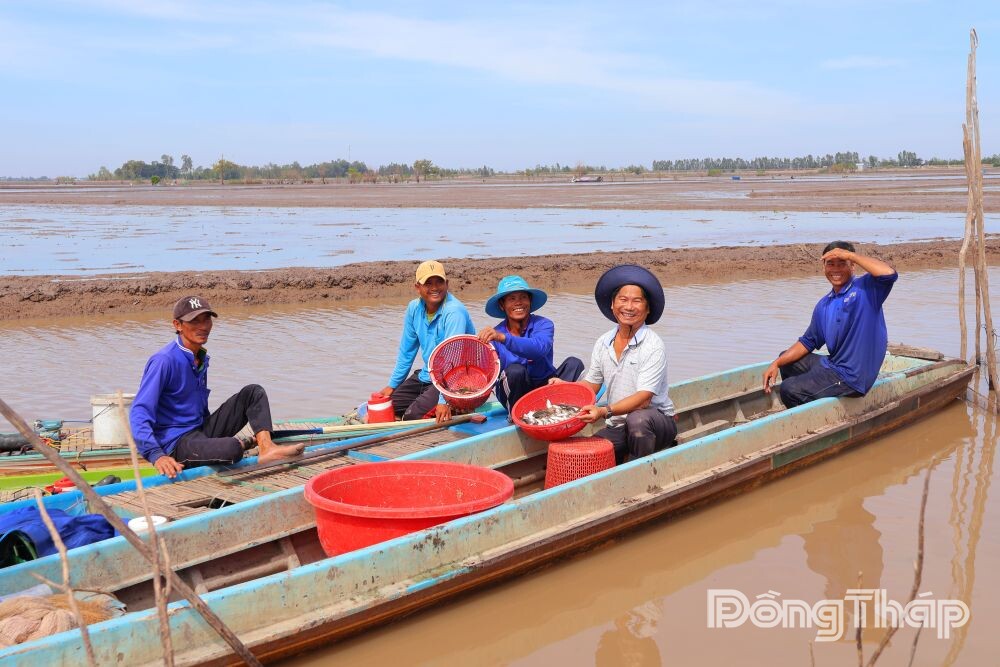
At Quyet Tien Ecological Agricultural Cooperative in Phu Tho commune, the model of storing and raising wild fish during the flood season has shown how locals are turning the flood season into a livelihood season.
Previously, floodwaters were often viewed as an obstacle to production; today, the water is harnessed as a natural resource. Storing and raising wild fish not only capitalizes on flood-season resources but also generates supplementary income, reducing dependence on a single production output.
In Giong Bang Hamlet, Thuong Phuoc Commune, the story goes a step further. The model of flood-season fish storage combined with experiential tourism shows that modern agriculture no longer stops at merely producing commodities.
By integrating with the landscape, the narrative of the floating season, and indigenous lifestyles, value is expanded into services, experiences, and community tourism. This is a vivid manifestation of the agricultural economic mindset: from a single unit of area, farmers can generate multiple layers of value instead of relying solely on yield.
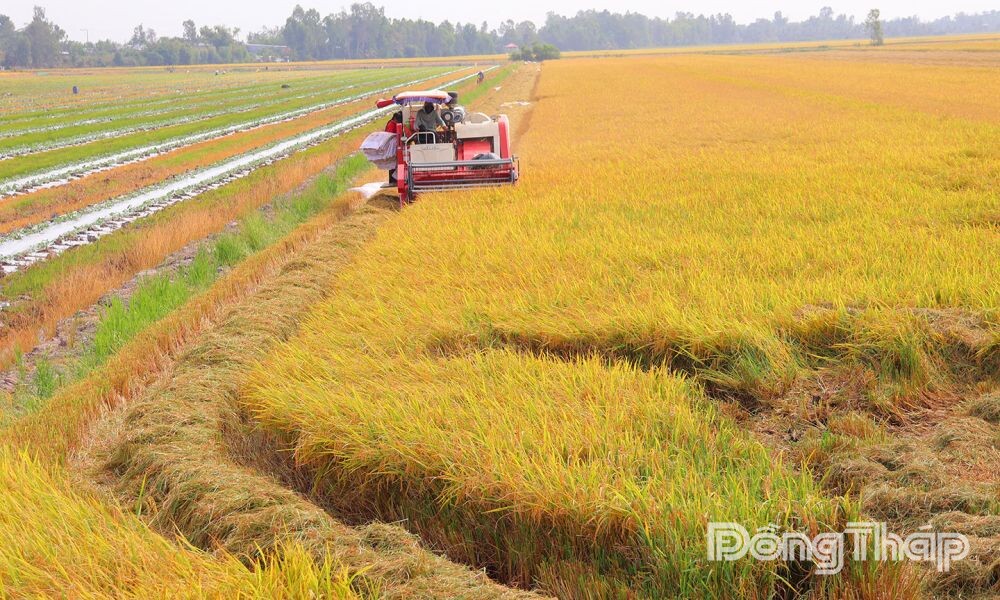
In Tam Nong and Tram Chim communes, the "Rice-Crane" model opens another dimension of "nature-based" agriculture. There, reducing the use of chemical fertilizers and pesticides is not only aimed at cutting costs or enhancing rice quality but also contributes to restoring the habitats of aquatic species and waterbirds, aligning production with ecological conservation goals.
The gain from this model is not just cleaner rice, but an improved ecological space—an agricultural practice that knows how to share benefits with nature.
WHEN PROVINCIAL ORIENTATION MEETS THE CRxN PROJECT VISION
Amidst Dong Thap’s push for "nature-based" agricultural development, the collaboration with WWF to implement Phase II of the CRxN project is seen as a timely step, creating synergy between local direction and international resources.
Funded by the Australian Government, the project aims to restore 1,750 hectares of freshwater ecosystems and support livelihoods for nearly 2,000 people in Dong Thap and Tay Ninh. The goal is to enhance resilience and promote climate-adaptive production.
The project's foundation was solidified during Phase I (2022–2025) in Lang Sen, Tay Ninh Province, with effective models such as floating seasonal rice, lotus-fish systems, straw mushroom cultivation, and the "1 Must, 6 Reductions" technique.
These models not only boosted income but also improved the environment. Notably, the water retention capacity of floating rice is 17.5 times higher, and the lotus model is 18.6 times higher than triple-crop rice, contributing significantly to the restoration of wetland ecosystems and biodiversity.
Regarding the implementation plan for Phase II, Mr. Huynh Quoc Thinh, Director of the Sustainable Agriculture and Food Program at WWF-Vietnam, stated that the project will focus on strengthening connections between farmers, cooperatives, businesses, and development organizations. It will promote flood-season livelihood models, low-emission rice production, and the development of value-added processed product lines with extended shelf lives to mitigate market fluctuations.
This approach aligns closely with the goal Dong Thap is pursuing: mastering not only production but also becoming strong in chain organization, market integration, and value addition.
From a management perspective, Mr. Le Ha Luun, Director of the Dong Thap Provincial Department of Agriculture and Environment, affirmed that the province is shifting strongly toward smart, climate-adaptive agriculture. In this shift, nature-based solutions are the key to restoring natural flood regimes, protecting the environment, and ensuring long-term livelihoods for the people.
This indicates that the CRxN project in Dong Thap is not opening a completely new path, but rather providing additional momentum to the path the province has already chosen.
The expected implementation of Phase II in areas such as Tram Chim, Tam Nong, and Truong Xuan carries high expectations. If well-organized, these will not just be isolated models but could become "links" in a larger ecological agricultural space where production, conservation, tourism, services, and markets mutually support one another.
Nature-based development, therefore, is not a retreat from nature but a leap forward in developmental thinking. It is when humans choose to walk alongside nature to develop more sustainably. On the foundation of the "New Dong Thap," this direction is becoming clearer and firmer, gradually opening a new chapter for the provincial agricultural economy.
By MY LY
Translated by X.QUANG