
Adapting to New Regulations to Sustain Agricultural Export Momentum
(DTO) Recently, sales of several key fruits in Dong Thap Province have hit a snag, causing prices to plunge. To address this, the province is rolling out multi-pronged solutions to elevate product quality and proactively adapt to new regulations in import markets.
FOCUSING ON QUALITY IMPROVEMENT
The province currently boasts around 135,000 hectares of fruit orchards, with durian and jackfruit dominating the acreage.
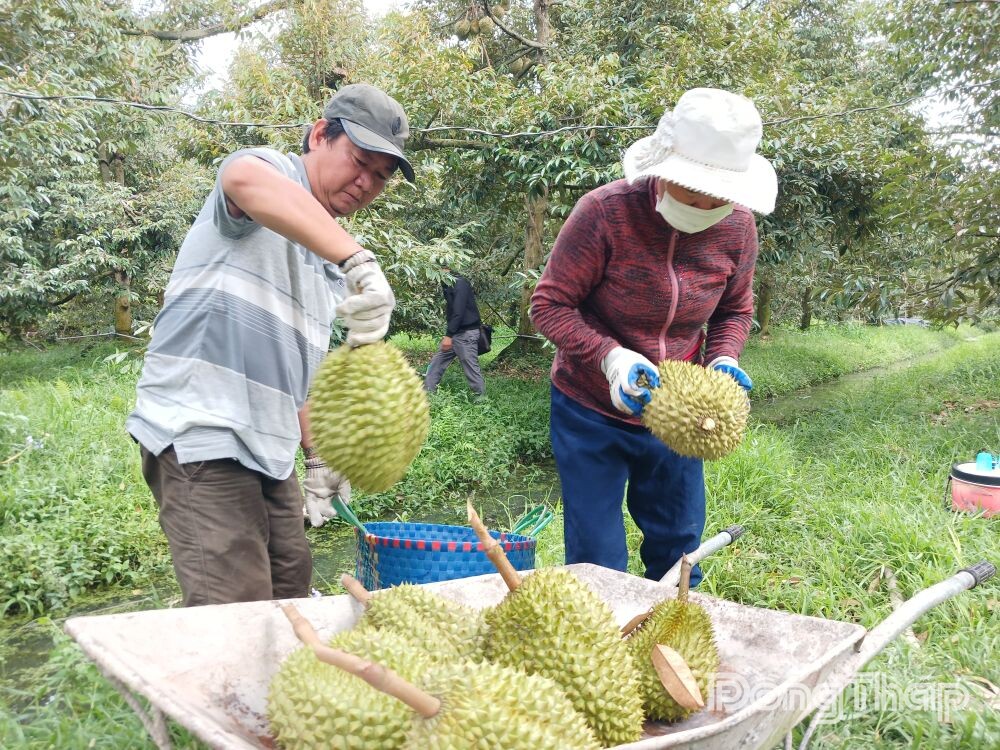
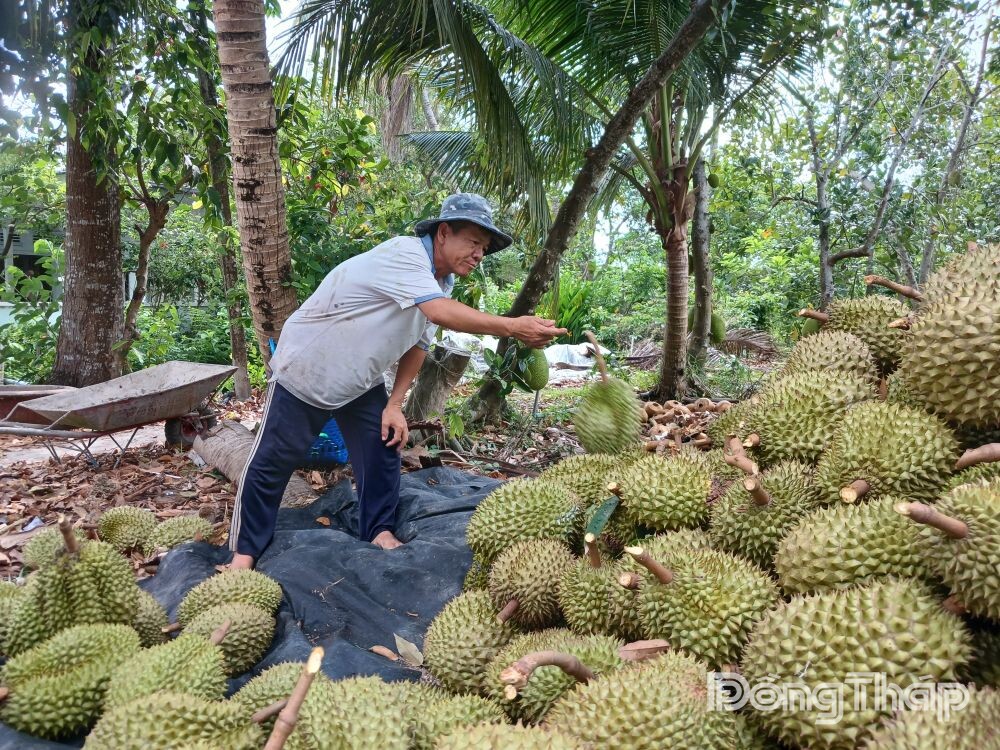
However, durian and jackfruit prices have plummeted just as the peak harvest season begins with massive volumes.
Specifically, durian production is estimated at about 111,220 tons (approximately 74,000 tons in May and 36,800 tons in June), while jackfruit output is projected at 68,300 tons (about 38,300 tons in May and 29,900 tons in June).
The primary cause for the price drop of durian and jackfruit is bottlenecks in cadmium and Auramine O testing. Testing centers approved by the Chinese side have temporarily suspended receiving samples from the Mekong Delta region, thereby impacting export activities.
According to the Dong Thap Provincial Department of Agriculture and Environment, actual monitoring of recent testing activities shows that the rate of durian and jackfruit samples in the Mekong Delta detecting cadmium indicators exceeding the allowable threshold tends to be relatively high, at around 30%. Therefore, to ensure sustainable consumption and export, it is imperative to focus on rectifying this situation.
According to the Director of the Dong Thap Provincial Department of Agriculture and Environment, Le Ha Luan, to remove difficulties in durian and jackfruit consumption, enterprises and raw material areas need to proactively control the quality of associated raw materials based on growing area codes.
One of the vital solutions is to classify raw material zones according to the risk level of cadmium residues in order to formulate appropriate purchasing plans. In parallel, the inspection and screening of raw materials must be conducted prior to packaging for export.
For farmers, it is essential to comply with safe cultivation processes and use fertilizers and pesticides according to instructions. Orchard owners must refrain from using input materials of unknown origin that pose a risk of heavy metal residues.
Furthermore, they need to maintain comprehensive production logs to facilitate traceability, and coordinate with enterprises and cooperatives in quality control and pre-harvest sample testing.
Farmers should regularly check soil pH (maintaining pH at 6.0–6.5) and supplement organic fertilizers, biochar, and beneficial microorganisms (SOFRI-VST 123) to manage cadmium levels in durian orchards.
PROACTIVELY ADAPTING TO CHINA'S DECREE 280
Reality demonstrates that China remains one of the largest and most important export markets for Vietnam in general, and Dong Thap Province in particular.
However, alongside the trend of tightening quality management, traceability, and food safety, the Chinese side continuously updates new regulations to elevate import standards.
Among these, Decree No. 280—which regulates the registration management of foreign food production enterprises exporting to China and will take effect this coming June—is one of the key regulations that enterprises, cooperatives, and farmers must grasp to adapt.
According to Master Dinh Duc Hiep from the Vietnam SPS Office under the Ministry of Department of Agriculture and Environment, Decree No. 280 replaces the previous Order 248 and officially enters into force on June 1, 2026. The preparation period for enterprises is relatively short.
Therefore, enterprises must pay special attention to avoid situations where exported goods to China fail to clear customs or are returned.
According to regulations and guidelines from China, previously granted growing area codes and packaging facility codes notified by the General Administration of Customs of China (GACC) will continue to be used, provided they were issued before the effective date of Decree 280. However, enterprises must note several crucial issues.
First and foremost, the registration account on the system must be managed by the enterprise itself and will remain unchanged. This is considered an "asset" of the enterprise. Therefore, the enterprise must directly hold and manage this account.
To support farmers, cooperatives, and enterprises in exporting durian and jackfruit more smoothly, the Dong Thap Provincial People’s Committee has recently issued an official request to the Ministry of Agriculture and Environment, proposing that food testing centers approved by Chinese authorities for Cadmium and Auramine O testing continue receiving samples and increase testing capacity for durian and jackfruit exports to China from the Mekong Delta region. In cases where testing centers must temporarily suspend sample reception, the province proposed that official notices should be issued at least seven days in advance so enterprises can proactively adjust their purchasing, production, and export plans. The Provincial People’s Committee also proposed that the Ministry of Agriculture and Environment work with the General Administration of Customs of China (GACC) to consider an appropriate post-clearance inspection mechanism, under which isolated testing discrepancies would not automatically result in the suspension of testing laboratories. This approach would help reduce pressure on domestic testing facilities receiving export samples. At the same time, the province requested the ministry to coordinate with GACC to soon organize assessments and approvals for additional qualified laboratories, including the Dong Thap Center for Research, Application and Science-Technology Services and Green Farm Vina Co., Ltd., in order to strengthen testing capacity for fruit exports in Dong Thap Province and neighboring localities. |
In case of any changes related to enterprise or product information requiring immediate supplementary entries, the enterprise must proactively update them on the system.
Enterprises need to verify whether their code status is suspended before executing exports. If an enterprise fails to manage its account or lacks sufficient information to update it, a code suspension will directly impact export activities.
During the suspension period, the enterprise must temporarily halt exports to resolve the issue, and normal exports should only resume once the situation is completely rectified.
This prevents cases where enterprises still ship goods while the code is suspended or not yet restored, leading to the risk of goods being returned. In such situations, the enterprise will bear substantial additional costs, as well as losses in time and effort.
Also according to Master Dinh Duc Hiep, enterprises need to coordinate closely with growing area code owners, farmers, and production facilities to jointly control the process.
Enterprises must exercise extreme caution regarding growing area codes and packaging facility codes that require modifications or are under review or suspension. During that period, exporting under these codes should not be pursued.
Previously, under Order 248, the GACC also noted that if goods were loaded onto vessels prior to the code suspension, the export could still be accepted. However, if goods were loaded after the suspension or freeze took effect, the shipment would be rejected outright.
Master Dinh Duc Hiep added: "To facilitate agricultural exports, state management agencies from central to local levels need to step up information dissemination, training, and guidance for enterprises, as well as organize periodic training sessions on China's import regulations and technical standards.
Simultaneously, they should develop detailed, accessible guide documents for enterprises and localities. One of the core tasks is to enhance inspection, supervision, and support for enterprises. Accordingly, state management agencies need to establish a chain-based monitoring mechanism from raw material areas to processing and export.
In parallel, post-inspection must be strengthened, and violations must be strictly handled to reduce the risk of warnings from the importing country. Special emphasis should be placed on proactively engaging in technical exchanges with China to remove barriers and handle non-compliant shipments."
In reality, meeting these new standards is not only an immediate requirement to resolve current output bottlenecks, but also a mandatory condition for Dong Thap agricultural products to enhance their competitiveness in the international market.
By T.DAT – H.THONG
Translated by X.QUANG