
TOWARDS GREEN AGRICULTURE:
Dong Thap Accelerates Emission Reductions
(DTO) To realize the goal of ecological and sustainable agricultural development, Dong Thap Province is focusing on implementing the Project “Low-Emission Crop Production for the 2025–2035 Period, with a Vision to 2050” (referred to as the Project). This is considered a necessary and inevitable direction for agricultural production today.
NUMEROUS ADVANTAGES
According to the Dong Thap Provincial Department of Agriculture and Rural Development (DARD), the locality possesses many advantages for implementing the Project
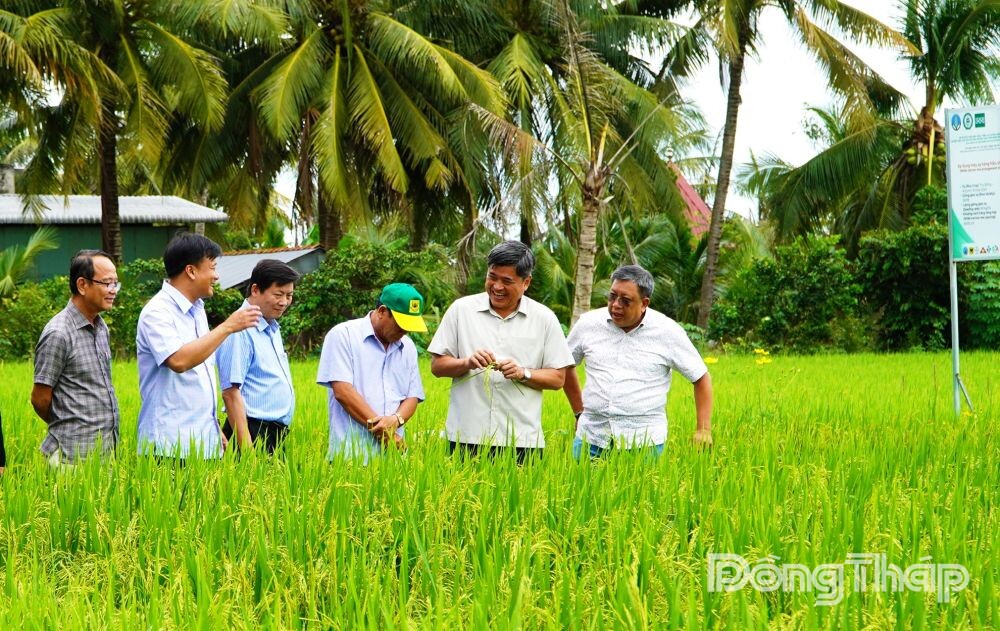
Firstly, the province boasts a large production scale with approximately 227,000 hectares of rice and over 134,900 hectares of fruit trees.
Additionally, the local irrigation system is relatively complete and several low-emission production models have begun to take shape. The locality also features a well-developed system of agricultural cooperatives with experience in linking with enterprises for production and consumption.
More importantly, the innovative mindset of Dong Thap farmers—who are always ready to adopt sustainable production models—is a key factor.
According to the DARD, the province has proactively prepared for the Project's implementation quite early.
According to the Project, Dong Thap aims for 100% of the province's rice cultivation area to adopt sustainable, low-emission farming processes by 2035, reducing greenhouse gas emissions by at least 20% compared to traditional farming methods. The province also targets at least 60% of the cultivation area for key fruit trees to implement low-emission processes, ensuring the efficient use of irrigation water, fertilizers, pesticides, and agricultural by-products. These practices will be gradually expanded to other crops suited to ecological conditions and market demands. The locality will establish and operate at least 10 pilot low-emission cropping models with clear economic and environmental efficiency to serve as a basis for evaluation, review, and scaling up. Simultaneously, at least 20 pilot models capable of Measurement, Reporting, and Verification (MRV) of emission reduction results will be implemented, gradually approaching carbon credit development mechanisms in the cropping sector when regulatory conditions are met. Furthermore, the province aims for at least 70% of low-emission cropping areas to be organized through cooperatives, collaborative groups, or partnership models with enterprises, integrated with traceability and stable consumption outlets. The income of farmers participating in low-emission cropping is expected to increase by at least 30% compared to traditional methods. At least 80% of low-emission production areas will be managed and monitored using digital tools, such as electronic logs, traceability systems, and digital management of water, fertilizers, pesticides, and emission tracking. Additionally, the province will build and develop a brand identity for key products produced under Dong Thap’s low-emission processes, linked to both domestic consumption and export markets. |
A vital foundation is the province's active participation in the "1 Million Hectares of High-Quality, Low-Emission Rice" project in the Mekong Delta.
Simultaneously, the province is implementing the TRVC Project (Transforming Rice Value Chains) to shift rice production towards lower emissions and higher value with the participation of businesses, cooperatives, and farmers.
Through practical implementation, many sustainable farming processes have been applied such as: rational irrigation management; reducing seeding rates; decreasing chemical fertilizers while increasing the use of organic and biological fertilizers; and integrated pest management (IPM).
Furthermore, the province is gradually changing the habit of burning straw after harvest, moving towards using straw as raw material for a circular economy.
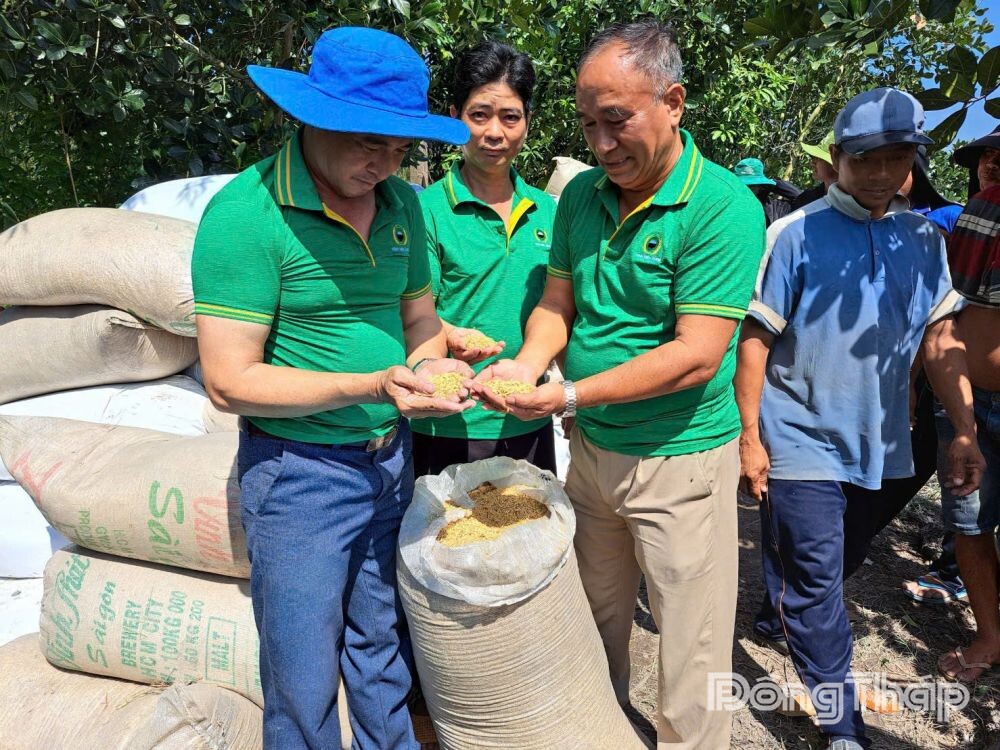
Mr. Nguyen Van Hung, Director of Thang Loi Agricultural Service Cooperative (My Qui Commune, Dong Thap Province), stated: “In previous years, farmers mainly produced on a small and fragmented scale with unstable outlets.
For over two years now, to improve product value, the cooperative has practiced high-quality rice cultivation under the 1-million-hectare low-emission rice project.
This model is very beneficial; besides support for rice seeds and fertilizers, farmers receive technical training to apply in production. Additionally, the cooperative links with enterprises to bring products into supermarkets and for export, helping farmers produce with peace of mind and increase their income.”
Vinh Hien Co., Ltd. (Phu Thanh Commune, Dong Thap Province) is one of the enterprises participating in links with cooperatives to produce high-quality, low-emission rice.
Mr. Huynh Van Danh, Director of Vinh Hien Co., Ltd., said that this Winter-Spring crop marks the third season the company has partnered with My Thanh Bac Agricultural Service Cooperative (My Thanh Commune, Dong Thap Province) to produce low-emission rice on 100 hectares.
This includes 50 hectares of Dai Thom 8 rice and 50 hectares of OM 18 rice. When produced under low-emission processes, the rice yields higher than those outside the model and reduces costs.
Notably, the company guarantees the purchase of all products from cooperative members at prices 200 - 300 VND/kg higher than the market rate. In recent days, despite falling rice prices, the company continues to purchase at the initial agreed price.
Not limited to rice production, Dong Thap is also promoting low-emission fruit tree production, increasing the use of organic fertilizers and biological pesticides, and managing nutrients and irrigation rationally. This is integrated with granting production unit codes (PUC) and ensuring traceability for key products such as mangoes, durians, oranges, and mandarins.
SCALING UP EMISSION REDUCTION MODELS
According to Mr. Le Ha Luan, Director of the Dong Thap Provincial Department of Agriculture and Rural Development (DARD), the province will continue to scale up sustainable rice farming practices within the framework of the Mekong Delta's "1 Million Hectares of High-Quality, Low-Emission Rice" project.
The focus is on the synchronous application of solutions such as: reducing seeding rates; rational irrigation management; decreasing chemical fertilizers while increasing the use of organic and biological fertilizers; and integrated pest management (IPM). Simultaneously, the province will prohibit the burning of straw after harvest and develop models for straw collection and processing to serve the circular economy.
The province is also strengthening linkages between enterprises, cooperatives, and farmers to organize production along value chains, enhancing both the quality and value of rice grains.
Regarding fruit trees, Dong Thap currently possesses approximately 134,900 hectares, featuring key sectors such as mangoes, durians, citrus fruits, and longans...
Among these, Cao Lanh mangoes and durians from the Cai Lay - Cai Be region are high-value export products.
The province will concentrate on building low-emission fruit cultivation models, increasing the use of organic fertilizers and biological agents, and managing water and nutrients rationally to reduce emissions from fertilizers and pesticides.
At the same time, it will develop production areas integrated with production unit codes (PUC), traceability, and export standards. This aims to gradually enhance the value and sustainability of the fruit industry.
Mr. Le Ha Luan further added: “In our strategic orientation, the province determines that the implementation of the Project must be integrated with the restructuring of the cropping sector towards ecological sustainability, emission reduction, and the enhancement of agricultural product value.
On this basis, the province will gradually establish and scale up low-emission production models for each key crop, thereby forming farming processes suited to the ecological conditions and characteristics of each industry.
Dong Thap will also promote the application of science, technology, and digital transformation in production area management; build monitoring, measurement, and reporting (MRV) systems for emission reductions; and strengthen training for farmers and cooperatives to effectively implement sustainable production processes.”
By NAM PHONG- T. DAT
Translated by X.QUANG