
Dong Thap Party Secretary Ngo Chi Cuong Surveys Proposed Investment in My Tho–Go Cong Transport Corridor
(DTO) On the afternoon of November 5, Mr. Ngo Chi Cuong, member of the Party Central Committee, Secretary of the Dong Thap Provincial Party Committee and Chairman of the Dong Thap Provincial People’s Council, led a delegation on a field survey of several transport projects to support the review and adjustment of planning and public investment plans for the 2026–2030 period.
The delegation surveyed the proposed site for the interchange connecting the My Tho–Go Cong route with the coastal road and Soai Rap Bridge; the Go Cong General Port area in Gia Thuan Commune; the intersection of the My Tho–Go Cong route with Provincial Road 877 and the Cho Gao Canal; and the Hung Vuong Square area.
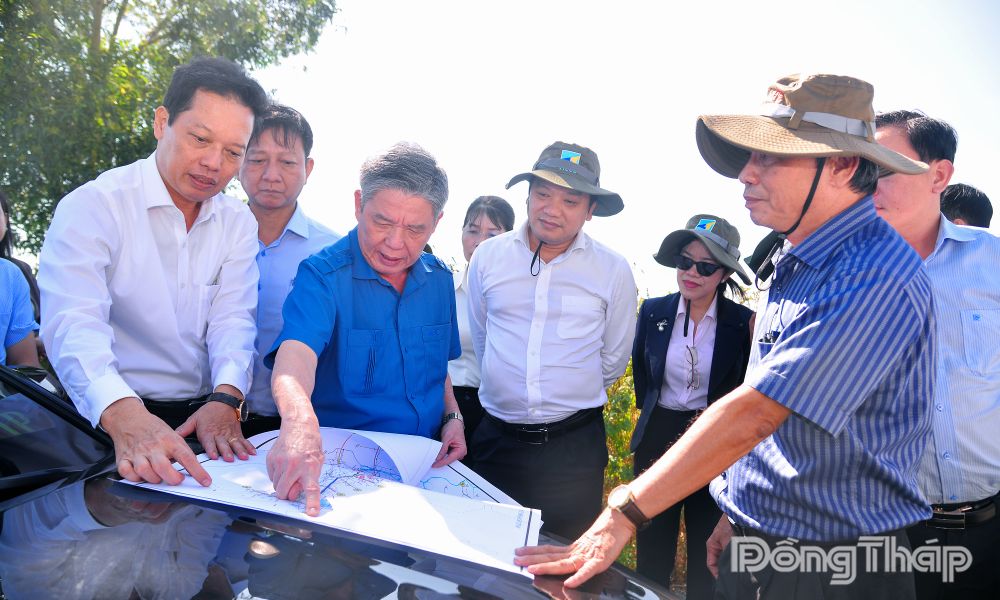
According to the planning documents, the My Tho–Go Cong connecting road is not yet included in the Dong Thap Provincial Master Plan for the 2021–2030 period, with a vision to 2050. The province is therefore considering adjusting the plan to incorporate the route into the provincial road network. It would start at the roundabout at Hung Vuong Square and end at the intersection with the coastal road, connecting to the Soai Rap Bridge to head towards Ho Chi Minh City. The route is expected to be approximately 42 kilometres long and designed to meet plain Grade II road standards, featuring six lanes for motor vehicles and two lanes for non-motorized traffic. The first phase is expected to comprise four motor vehicle lanes and two non-motorized traffic lanes.
The survey aims to provide a basis for adjusting and supplementing planning, identifying project portfolios and studying investment policy proposals for the transport corridor linking the Cao Lanh area with the Go Cong coastal area. This will gradually improve the transport network and strengthen connectivity among areas across the province.
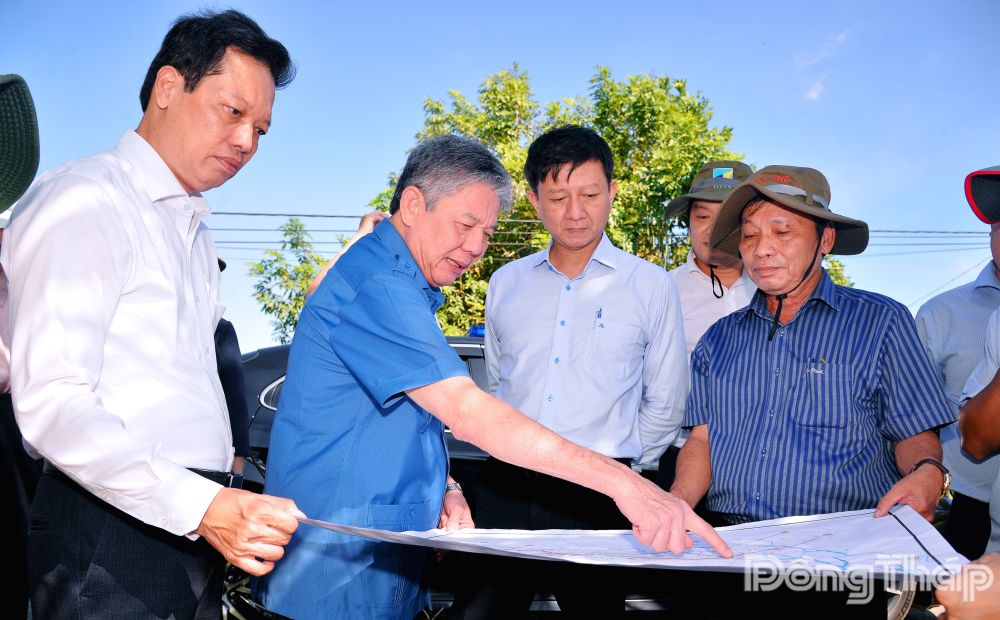
Regarding the Hung Vuong Boulevard Project, which is expected to stretch approximately nine kilometres from the Than Cuu Nghia interchange in Long Hung Commune to the intersection of Hung Vuong Road and National Highway 50 in Dao Thanh Ward, the delegation heard reports on proposed alignments, including the section connecting through the Hung Vuong Square area.
After reviewing the horizontal alignment and proposed options, Secretary Ngo Chi Cuong called for further study of a traffic connection that would not pass through the central area of Hung Vuong Square.
He noted that building a road through this location could disrupt the existing spatial layout and planning structure, while affecting cultural activities and events regularly held at the square.
Secretary Ngo Chi Cuong stressed that Hung Vuong Square is an important public project whose planning and construction had been studied and undertaken by successive generations of provincial leaders. Therefore, any transport plan must preserve the square’s space and functions. He also called for studying an appropriately shifted route that makes use of the remaining public land, creates conditions for urban expansion behind the square and enables more effective use of land for commercial and service development.
Secretary Ngo Chi Cuong asked the Department of Construction to work with the consulting unit to continue studying and analysing alternative alignments, assessing their potential connections with National Highway 50, the effectiveness of land use and urban development potential. These considerations must ensure a balance between transport infrastructure development and the preservation of the existing architectural space and landscape.
By HA NAM
Translated by X.QUANG