
Dong Thap Promotes Sustainable Livestock Farming
(DTO) Dong Thap’s husbandry sector is gradually strengthening its role in the agricultural economy, shifting from small-scale traditional farming to larger-scale operations that apply advanced technologies and comply with biosecurity procedures to meet increasingly stringent market requirements.
ENSURING SAFETY STANDARDS
According to the Dong Thap Department of Agriculture and Environment, the province has more than 505,000 pigs, up 4.71% year on year; over 148,000 cattle, equivalent to 96.91% of the figure recorded in the same period last year; approximately 2,100 buffaloes; and around 24 million poultry, up 0.71 year on year. In aquaculture, the area stocked over the first nine months reached approximately 21,210 hectares, equivalent to 92.26% of the annual target. Aquaculture output exceeded 815,000 tonnes, up 9.21% year on year.
To develop animal farming sustainably, create jobs, and stabilize people’s livelihoods, Dong Thap has in recent years focused on restructuring the sector toward higher quality, efficiency, and safety, while actively protecting the environment in farming areas and safeguarding public health.
Accordingly, the province is planning key livestock farming zones suited to local conditions and gradually shifting from small household operations to concentrated farming. Farmers are being encouraged to adopt biosecurity and disease-prevention procedures and apply technological advances.
The provincial Department of Agriculture and Environment is also encouraging farm owners to invest in modern, well-equipped facilities, strengthen disease control, and develop livestock value chains that ensure reliable input supplies and product outlets, reduce costs, and improve economic efficiency.
In poultry farming, many facilities are focusing on information technology and developing traceability software to manage inputs, production processes, and finished products, enabling origin tracing and ensuring food safety.
Mr. Nguyen Tan Cuong, Vice Chairman of the Dong Thap Union of Science and Technology Associations, said: “In the current context, developing livestock farming through advanced technologies and compliance with biosecurity procedures has become an inevitable trend, helping better meet market demand at home and abroad. “In recent years, the Union has coordinated with the provincial Livestock Association to produce the ‘Knowledge for Daily Life’ segment, featuring ‘The Livestock Sector Sustains Growth and Stands Ready to Serve the Tet Market,’ as well as the ‘Science and Technology Intellectuals’ special feature. |
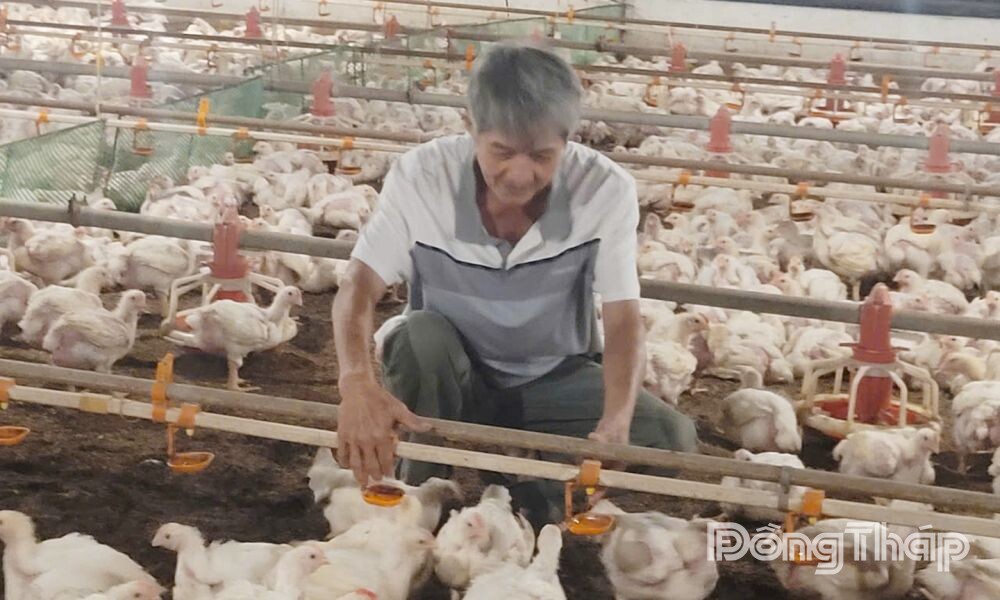
One example is Mr. Nguyen Duc Lu, who lives in Quarter 17, Dao Thanh Ward. Driven by his passion for livestock farming, Mr. Lu gradually gained knowledge and experience while exploring new production methods.
Mr. Lu said he recognized that small-scale farming carried many risks, whereas biosecure production using technology and links with businesses offered greater prospects. He therefore continued researching industrial chicken farming in climate-controlled barns.
Drawing on the knowledge he had accumulated, Mr. Lu made the decision to invest and gradually refine his farming procedures. He signed a contract with Japfa to raise Cobb 500 broiler chickens for supply to supermarkets and catering kitchens in industrial parks nationwide. Under the agreement, the company provides chicks, technical support, and a guaranteed market for the finished products.
A key feature of the model is that the chickens are raised entirely in enclosed barns equipped with air conditioning, exhaust fans, and environmental control systems.
Mr. Lu now operates three farms covering a total area of more than 5,000 square meters, with a combined capacity of over 60,000 chickens. After approximately 45 days, the chickens reach an average weight of around three kilograms each and are sold under the contractual terms.
With farm-gate prices of approximately VND 31,000–32,000 per kilogram, and sometimes higher, Mr. Lu earns an average profit of VND 5,000–8,000 per kilogram. His farms ship approximately five batches of chickens each year, generating annual revenue of VND 20–25 billion and a profit margin of around 10%.
In addition, some livestock and poultry farms are adopting and maintaining certifications for good farming practices to produce high-quality goods trusted by consumers, ensure food safety and hygiene, protect the environment, and move toward building their own brands or registering for provincial recognition under the One Commune One Product (OCOP) program.
Mr. Doan Phan Dinh, Director of Dong Thap Wild Boar Trading and Services Co., Ltd. in Tan Nhuan Dong Commune, has developed a hybrid wild boar farming model under the motto “Profitable for farmers, beneficial for consumers.” His company has established partnerships with more than 5,000 farming households raising wild boars across the Mekong Delta provinces.
Mr. Dinh said that, to meet required standards, all participating households must ensure the agreed quantity and quality of supply under their contracts. Antibiotics are prohibited in raising the pigs, and farmers are encouraged to feed them vegetables, fruits, grass, and agricultural by-products to increase product value.
TOWARD SUSTAINABLE LIVESTOCK DEVELOPMENT
According to the Dong Thap Department of Agriculture and Environment, the province will continue expanding large-scale farm models and promoting the widespread application of advanced science and technology in livestock production.
The province is stepping up communications to raise livestock farmers’ awareness, while providing training and guidance on applying modern technologies to concentrated, large-scale farming operations.
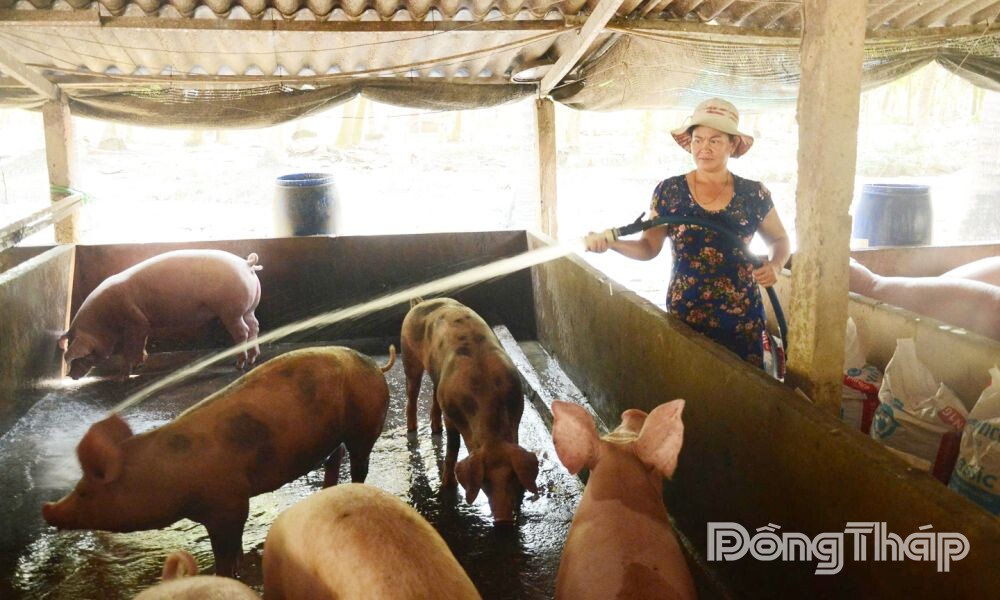
The family of Mr. Duong Tan Si in Tan Thoi Commune is among the local households with extensive experience in pig farming. To improve production efficiency, Mr. Si has proactively developed an integrated closed-loop farming model, combining biosecurity measures to reduce costs, limit disease risks, and protect the environment.
Under this model, Mr. Si raises breeding sows and retains the piglets for commercial growth. He also operates a livestock feed business, enabling him to secure feed supplies at lower prices than those offered by outside dealers.
By optimizing input costs, his family has reduced pork production costs by approximately VND 1 million per 100 kilograms compared with small-scale households using traditional farming methods. Depending on the period, the farm’s total pig herd ranges from 200 to 500 animals.
The feed fermentation process consists of two stages. In the first stage, Mr. Si mixes microbial cultures, molasses, alcohol, vinegar, garlic culture, and boiled, cooled water to produce a fermented starter. Once the mixture has fermented successfully, he evenly pours three liters of the starter over a 25-kilogram bag of livestock feed and mixes it thoroughly.
The mixture is then placed in a plastic bag, sealed in two layers, and left to ferment for another seven to 14 days. When the feed develops a pleasant fermented aroma and a mildly sour taste, it is ready to be fed to the pigs.
Mr. Si said combining closed-loop farming with biosecurity measures and improved nutrition is essential to enhancing economic efficiency, reducing costs, and moving toward sustainable livestock production.
These approaches can increase output and improve product quality, limit disease, protect livestock, reduce environmental pollution, improve productivity, and ensure more consistent product quality. They can also lower production costs and prices, reduce environmental impacts, and support the widespread adoption of good livestock farming practices, such as VietGAP and GlobalGAP.
In addition, the province plans to apply information technology to livestock herd management and animal disease prevention and control by developing a database software system for pig and poultry farming. Other measures include developing and registering brands through certification marks or geographical indications, and applying product traceability systems to poultry products in general.
By NAM PHONG – MINH THANH – TRAN DAM
Translated by X.QUANG