

Dong Thap Removes Bottlenecks To Accelerate Construction Sector Growth
(DTO) Due to the impact of multiple factors, growth in Dong Thap’s construction sector fell short of targets over the opening months of the year.
To achieve the province’s 2026 economic growth target of 8–8.5%, Dong Thap is aggressively removing systemic bottlenecks to position construction as a primary driver of economic expansion.
GROWTH FALLS SHORT OF EXPECTATIONS
During the first few months of the year, particularly during the March peak, Dong Thap’s construction sector in particular, and the country as a whole, suffered major impacts from unfavorable factors.
Construction enterprises operating in the province have faced great difficulties as material supplies became scarce and prices surged well above project cost estimates.
Sharp increases in fuel prices have further compounded these challenges. Rising fuel costs, coupled with relentlessly escalating material prices, have forced enterprises to struggle to manage.
In addition, site clearance remains a critical stage disrupting construction schedules. In reality, many projects have stalled due to difficulties in compensation and support.
Piecemeal site handovers have prevented contractors from maintaining operational continuity, resulting in fragmented worksites, inflated labor costs, prolonged equipment downtime, and degraded construction efficiency. These compounding factors have driven up overall project costs, derailed implementation schedules, and choked public investment disbursement.
According to N.V.T., Director of a company specializing in transport infrastructure construction in Dong Thap Province, his business fell into a loss-making situation during the first months of the year due to skyrocketing construction costs. '
Several projects have also experienced delays due to site clearance snags, forcing timeline extensions and racking up additional expenses.
Amid these industry challenges, the province recorded encouraging milestones in social housing development.
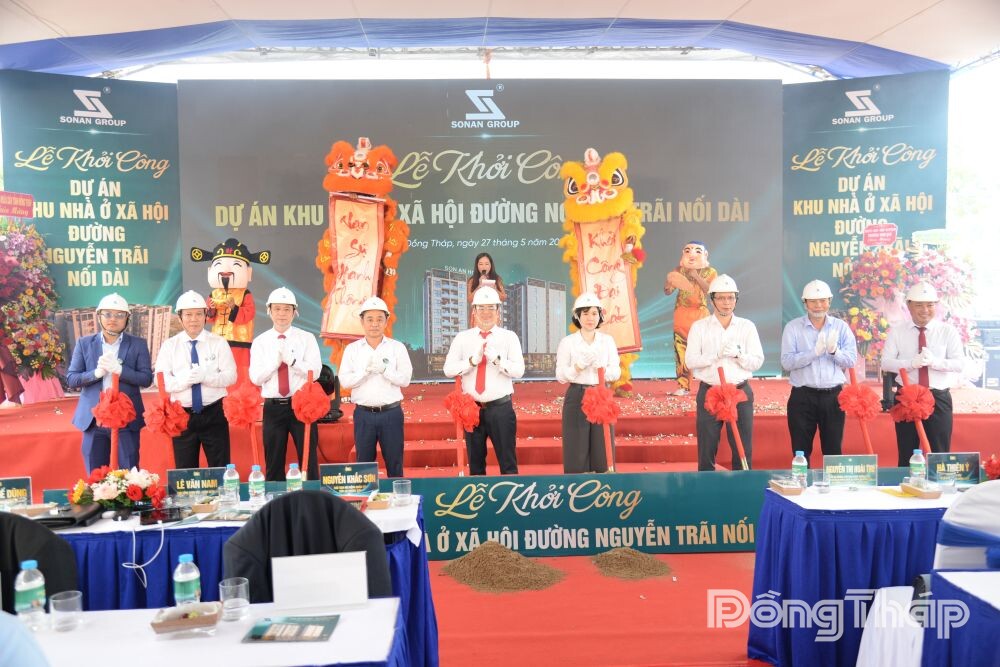
Since the beginning of the year, three new social housing projects have broken ground: the Nguyen Tri Phuong Social Housing Project (My Tho Ward); the Nguyen Trai Extension Social Housing Project; and the Nguyen Trong Dan Extension Social Housing Project.
Among them, the Nguyen Trai Extension Social Housing Project represents a total investment of VND357 billion. The development will deliver 276 social housing apartments together with more than 3,000 square meters of commercial and service floor space, meeting the housing needs of more than 1,000 residents.
According to Nguyen Khac Son, Chairman of the Board of Directors of Son An Huong Son Joint Stock Company (the project's developer), the company fast-tracked legal procedures, planning, design work, and the selection of top-tier consultants and contractors immediately after being appointed as the investor, ensuring the project proceeds on schedule and meets stringent quality standards.
Statistics show that Dong Thap currently hosts 12 social housing projects with a combined capacity of 4,749 apartments. By the end of 2025, four projects had reached completion, providing 1,175 apartments. At present, six social housing projects are under active construction, including: the Tan Huong Industrial Park, the Provincial Trade Union, My Phu, Nguyen Trai Extension, Nguyen Tri Phuong, and Nguyen Trong Dan Extension social housing developments.
According to Nguyen The Hong Trung, Director of the Dong Thap Department of Construction, the province's construction sector expanded by 7.4% in the first six months of 2026, significantly lagging behind the projected 12.58% target.
Overall, construction growth during the first half of the year was driven mainly by ongoing public investment projects carried over from 2025.
Meanwhile, new growth catalysts—including urban development, residential and social housing projects, and private-sector investment—have yet to make significant contributions to this growth.
In addition, sluggish pre-investment pipelines, slow public investment disbursement, acute shortages of construction materials such as sand and stone, the stagnant recovery of the real estate market, and highly volatile material and freight costs continue to directly undermine project timelines and investment returns.
FOCUS ON DISMANTLING BOTTLENECKS
According to Mr. Nguyen The Hong Trung, urgently dismantling key gridlocks in investment attraction, site clearance, and building material supplies is essential for the province to achieve its 2026 construction-sector growth target.
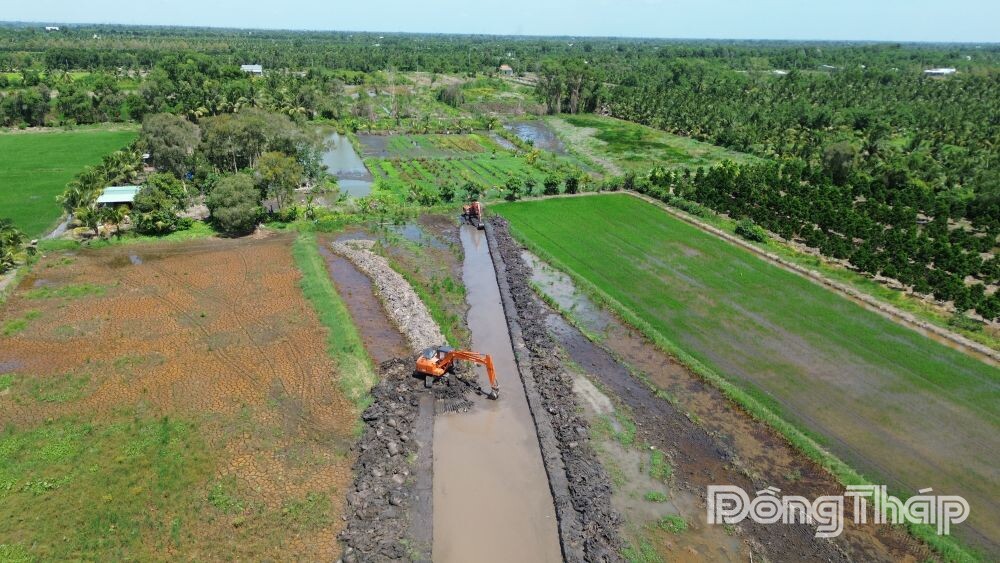
These efforts are expected to play a decisive role in enabling the sector to meet its growth target during the second half of the year.
To fulfill the province’s 2026 socio-economic development targets, the construction sector must achieve a 16.44% growth rate during the remaining months of the year. Accordingly, the Department of Construction will continue providing strategic counsel to the Provincial People's Committee on a suite of core initiatives.
According to Mr. Nguyen The Hong Trung, the department will further enhance its policy advisory and operational oversight efficiency while keeping a close watch on performance trends within the sector.
The department will advise the Provincial People's Committee on effectively implementing development targets and solutions, conduct monthly reviews of economic scenarios, assess both objective and subjective factors, pinpoint existing roadblocks, and deploy timely interventions.
A cornerstone of these initiatives will be accelerating transport infrastructure investment and public investment disbursement.
The Department of Construction will advise the Provincial People's Committee to issue a comprehensive transport infrastructure development plan in alignment with the Provincial Party Committee’s resolution. At the same time, the province will ramp up public capital disbursement, designating it as a top-priority political mandate.
Priority resources will be concentrated on site clearance, compensation, and resettlement for mega-projects, including the coastal road section passing through the province and Provincial Road 877C.
Meanwhile, the province will expedite major ongoing projects and newly initiated developments, including the upgrading and expansion of Provincial Road 878 and the Dong Thap Muoi Regional Development Road, helping fuel growth in the sector.
In parallel, the Department of Construction will closely coordinate with central authorities to expedite key expressway projects in the locality, including the expansion of the Ho Chi Minh City – Trung Luong – My Thuan Expressway and the My An – Cao Lanh Expressway, while accelerating pre-investment pipelines for flagship projects under the 2026–2030 medium-term public investment plan.
Regarding planning and urban development, Mr. Nguyen The Hong Trung said the department will prioritize finalizing five major zoning plans assigned by the Provincial People's Committee (covering Go Cong, My Tho, Cai Be, Sa Dec, and Cao Lanh).
At the same time, it will guide, expedite, and supervise 77 local planning blueprints, including 16 urban planning schemes and 61 commune master plans.
The department will continue advising the Provincial People's Committee on implementing urban development programs, upgrading urban planning quality, and enforcing strict compliance with construction regulations. Development schedules will be actively expedited for key urban projects, such as the An Hoa Residential Area and the New My Phu Residential Area.
In addition, the province aims to break ground on one more social housing project this year, bringing the total number of new starts in 2026 to four, with a combined capacity of approximately 1,260 units.
The Department of Construction will also continue advising the Provincial People's Committee on appointing developers for at least three additional social housing projects. Currently, the department has submitted the Bình Thạnh Social Housing Project, with an estimated capacity of around 900 units, to the Provincial People's Committee for approval, while actively inviting investment bids for the My Hiep social housing development. The department will continue monitoring implementation and coordinating efforts to untangle snags affecting ongoing social housing projects throughout the province.
“In the coming period, the Department of Construction will maintain routine coordination with project developers and local authorities to review project pipelines and promptly advise on actionable solutions to hurdles related to investment procedures, material supplies, quality control, and cost management,” Mr. Nguyen The Hong Trung said.
He added that the department would rigorously enforce regulations on publishing construction material prices, labor unit costs, and construction price indices.
“The construction sector will also continue driving administrative reforms, scaling up IT applications, and sharpening the quality of technical appraisals—particularly for schools in border communes and the province’s high-profile development projects,” he noted.
By M. THANH
Translated by X.QUANG