
Dong Thap: Strategic Breakthroughs to Elevate Education Standards
(DTO) With a solid foundation built over recent years, in 2026, Dong Thap province’s Department of Education and Training (DOET) aims to implement breakthrough solutions to propel the province's educational sector to new heights.
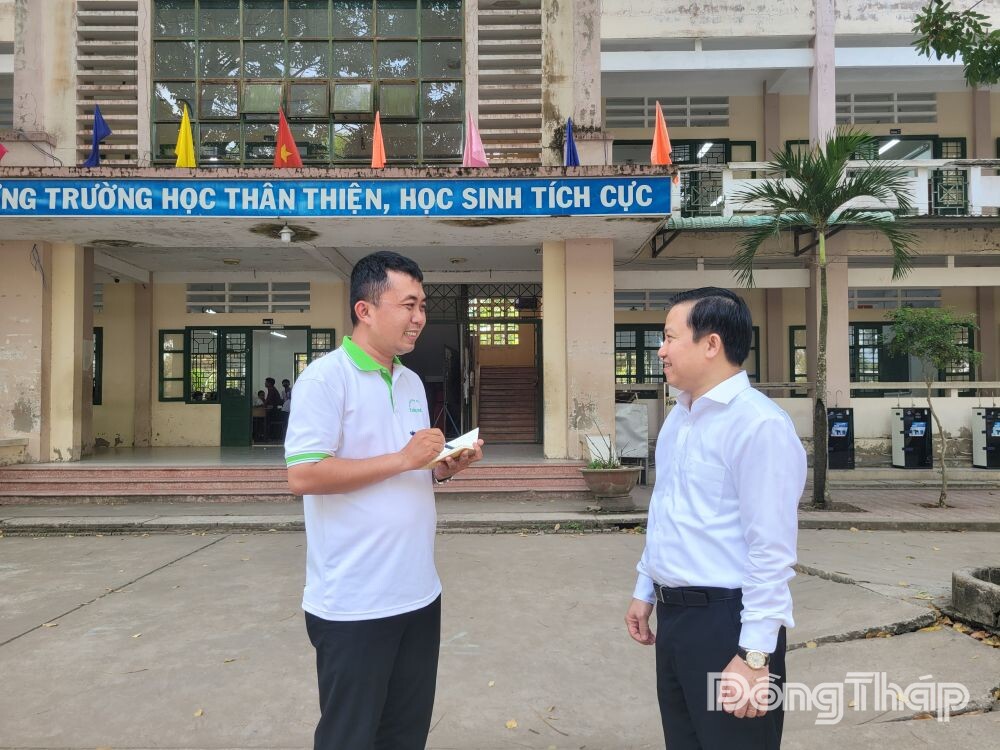
On the occasion of the New Year, Dong Thap Newspaper, Radio, and Television held an interview with Dr. Le Quang Tri, Member of the Provincial Party Committee and Director of the Dong Thap Department of Education and Training, to clarify key orientations for the coming period.
Reporter: First of all, Dr. Le Quang Tri, could you please share the key milestones and prerequisites for Dong Thap’s education sector as we enter 2026?
Dr. Le Quang Tri: Over the past years, thanks to the attention of the Provincial Party Committee and the Provincial People's Committee, along with the collective responsibility of our educators, the entire sector has achieved many outstanding results. These are considered vital prerequisites for the education sector to confidently step into 2026.
General education in the province has gradually stabilized and become well-organized. The mobilization of school-age children into Grade 1 has been maintained at 100%, ensuring the steady results of universal primary education.
The organization of two-session-per-day schooling continues to be promoted. The sector has expanded the day-boarding model to reduce pressure on parents while enhancing care and educational conditions for students.
The quality of foreign language and information technology (IT) instruction has improved significantly. Compared to the 2024–2025 school year, the percentage of primary school students learning English and IT has shown distinct growth, especially in rural areas.
The Department of Education and Training (DOET), in coordination with commune and ward People's Committees, has rearranged preschool and general education institutions in accordance with current regulations. The high school entrance examination was organized safely and strictly, adhering to regulations and accurately reflecting students' actual abilities, ensuring fairness and objectivity in admissions.
Reporter: What are the current challenges facing the sector, sir?
The sector continues to enhance comprehensive education. Creative experiential activities and life skills education will be strengthened to help students develop practical and adaptive competencies. The integration of digital technology will be deepened in both teaching and management, aiming to train a skilled workforce that meets the socio-economic development requirements of the new era. |
Dr. Le Quang Tri: Although the school network has received significant investment, its distribution is not yet truly equal, particularly in rural and border areas.
The number of general schools that have not yet met National Standards stands at 168, accounting for 23.4%. Additionally, every year, schools that have completed their 5-year certification period must undergo re-evaluation (estimated at 309 out of 718 schools for the 2025–2030 period, or 43%), which requires substantial investment resources.
The proficiency and skills of teachers remain uneven across regions; a small segment of teachers has yet to keep pace with the requirements for innovative methods and the application of technology in teaching. Students in rural areas still face limitations in soft skills, technological access, and learning conditions compared to their urban counterparts.
Reporter: Looking ahead to 2026, what are the fundamental solutions the sector will implement to develop and elevate Dong Thap’s education and training?
Dr. Le Quang Tri: Entering 2026, the education sector has clearly defined its focus: consolidating the foundation, narrowing the regional gap, and improving quality in a substantive and sustainable manner.
First, the school network will continue to be reviewed and refined toward a streamlined and efficient structure. Investment in building and upgrading facilities will be prioritized for National Standard schools, especially the multi-level school models in border areas.
Simultaneously, the sector will evaluate and rearrange schools with multiple satellite sites following a suitable roadmap, ensuring both students' learning rights and teachers' working conditions.
Our goal is to gradually increase the ratio of National Standard schools to a higher level, creating a balanced foundation across all localities.
Alongside infrastructure investment, the sector will focus on personnel development in 2026.
Professional training programs and skill enhancement will be intensified, aligned with the requirements of innovative teaching methods and digital transformation.
Recruitment and placement of teachers will be closely coordinated to ensure sufficient numbers and a balanced structure, with priority given to rural and border areas—regions that still face human resource challenges.
In terms of quality, the sector continues to promote comprehensive education. Creative experiential activities and life skills education will be strengthened to help students develop practical and adaptive abilities.
The application of digital technology will be deeply integrated into teaching and management, aiming to train a skilled workforce that meets the socio-economic development requirements of the new era.
Regarding examinations, the sector will continue to strictly direct and manage the high school entrance and graduation exams. Guidance documents will be issued promptly, specifically, clearly, and scientifically, staying close to practical realities.
All efforts are aimed at ensuring that exams take place according to schedule, safely, seriously, transparently, objectively, and with high quality.
With these defined tasks, 2026 will be implemented with a synchronized spirit—from infrastructure and personnel to teaching quality and examinations—creating a proactive stance from the start to ensure all activities are well-organized, effective and profound.
Reporter: In the Year of the Horse 2026, do you have a message for the officials, teachers, and students across the sector?
There is a significant amount of work ahead; therefore, more than ever, I hope that our staff and teachers, who have already exerted great effort, will strive even harder. We must remain united, focus our collective intellect, and excel in our academic year tasks; continuously train to improve professional expertise, innovate teaching methods, and effectively carry out emulation movements, serving as role models for students to follow. |
Dr. Le Quang Tri: To successfully fulfill our missions in 2026, the joint efforts and collective responsibility of all teachers in the education and training sector are vital.
There is much work ahead; therefore, more than ever, I hope that our staff and teachers, who have already exerted great effort, will strive even harder. We must unite, focus our intellect, and excel in our academic year tasks; continuously train to improve professional expertise, innovate teaching methods, effectively carry out emulation movements, and serve as role models for students.
For the students, I encourage you to study hard, be obedient to your grandparents, parents, and teachers; actively participate in activities, hone your life skills, and strengthen your moral and lifestyle training.
Reporter: Thank you, Dr. Le Quang Tri!
By DO PHI
Translated by X.QUANG