
Dong Thap Tourism Makes a Remarkable Breakthrough
(DTO) – The year 2025 marked a new milestone for Dong Thap’s tourism sector with impressive growth figures. Moving beyond merely welcoming millions of visitors, the province is repositioning itself on the Mekong Delta tourism map by transforming agriculture into heritage, rustic charm into professional services, and adopting "green tourism" as the foundation for sustainable development.
A NEW STATURE FOR TOURISM
By the end of 2025, while the broader economic landscape still showed mixed signals amid market fluctuations, Dong Thap tourism emerged as a bright spot with compelling growth.

This is not only a result of relentless efforts but also a testament to the vibrant vitality of the "Land of the Pink Lotus" tourism brand.
According to year-end reports, the province welcomed and served over 7.3 million visitors, a 19.8% increase year-on-year, reaching 101.5% of the annual target. A proud highlight was the strong return of international tourists, totaling 766,312 arrivals, up 23.6%.
Total tourism revenue hit VND 4.158 trillion, a 21.5% increase, significantly contributing to the province's GDP structure and its socio-economic development targets.
The “tourism boom” in Dong Thap was most evident during the Lunar New Year of the Fire Horse (Tet Binh Ngo) 2026. Within just seven peak days, from the 27th day of the twelfth lunar month to the fourth day of the new year, the province welcomed more than 422,500 visitors, generating VND 170 billion in revenue.
Accommodation occupancy rates in key urban centers remained consistently high at 75%–80%, reflecting the strong and sustainable demand from visitors for a destination that is safe, friendly and rich in cultural identity.
Dong Thap’s breakthrough is the result of a well-structured transformation process aimed at sustainability.
Following the implementation of policies to merge administrative units and expand development space, the province has skillfully turned its inherent potential into highly competitive tourism products.
For Dong Thap, agricultural, ecological and orchard-based tourism is no longer a temporary measure but has become a strategic pillar.
According to the Department of Culture, Sports and Tourism, Dong Thap Province currently has 94 travel businesses, including 54 domestic travel agencies, 25 international agencies, and 2 transport service providers, along with 11 branches (5 domestic and 6 international) and 2 representative offices (1 domestic and 1 international). The province has 460 tourist accommodation establishments with more than 7,900 rooms, including 56 hotels rated from 1 to 3 stars and 404 establishments eligible for operation under current regulations. |
Green tourism is serving as a crucial catalyst, enabling farmers to generate multiple times the added value from the same area of agricultural land.
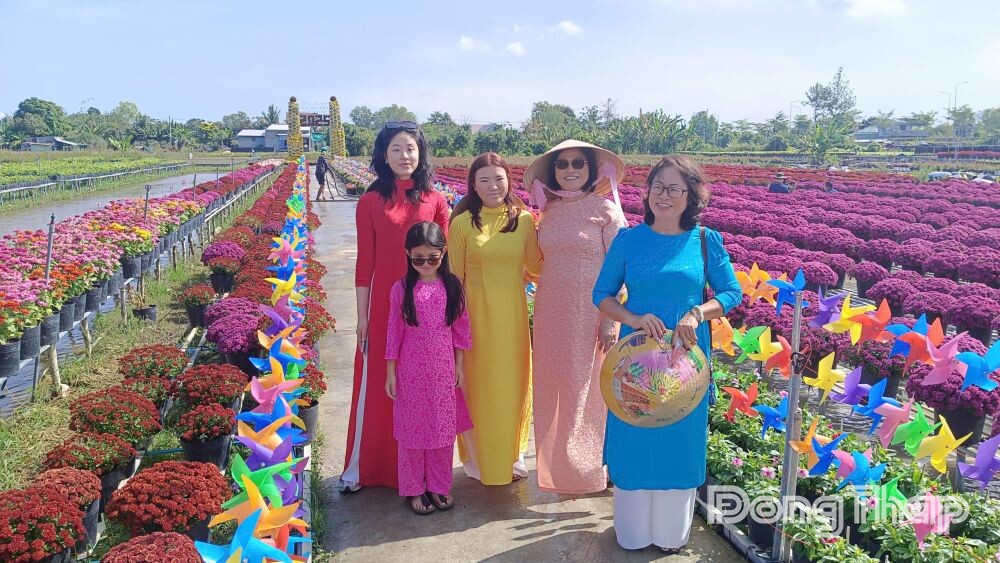
This approach has become a solid foundation for extending agricultural value chains and building sustainable rural communities. Images of Lai Vung pink mandarin orchards heavy with fruit, the vibrant Sa Dec Flower Village, and community-based tourism sites on lush river islets have become unforgettable destinations for visitors.
Here, tourists do not simply come to sightsee; they immerse themselves in the rustic and simple life of local farmers. They can experience farming activities, pick fruit with their own hands, enjoy lotus tea and breathe in the fresh air of rivers and rice fields.
In the fast-paced and stressful rhythm of modern urban life, these authentic values have become the most precious “healing remedy” that Dong Thap offers.
Another highlight in 2025 was the province’s promotion, marketing and regional cooperation efforts. With the mindset that “to go far, we must go together,” Dong Thap actively strengthened partnerships with Ho Chi Minh City and neighboring provinces to develop distinctive inter-provincial and regional tourism routes.
A series of large-scale cultural events were successfully organized, creating strong public interest, including the 6th Dong Hoa Hiep Ancient Village Culture and Tourism Festival themed “Memories of the Ancient Village”, a seminar on promoting historical and cultural heritage values linked with tourism, and specialized Fam trip survey programs.
These events not only attracted visitors but also opened up investment opportunities for major travel companies.
At the same time, Dong Thap has shown agility in fully leveraging the power of digital technology. The “Vi Vu Dong Thap” program on social media platforms and television has created a strong ripple effect, bringing the image of the Pink Lotus Land closer to young audiences and international travelers.
The deployment of electronic information systems, tourism portals, and digital transformation in tourism management has also enabled visitors to access services, book accommodations and explore destinations easily with just a tap.
To date, the province has 150 tourist sites, including 32 officially recognized by the provincial People’s Committee, and 75 certified service establishments.
These figures reflect the sector’s growing professionalism, gradually shedding its “spontaneous” nature and taking on the appearance of a modern service industry.
BUILDING THE TOURISM BRAND
To ensure visitor satisfaction, Dong Thap has placed strong emphasis on human resource training.
Local farmers engaged in tourism in Dong Thap are now not only hospitable but also equipped with professional service skills, ranging from communication and food presentation to storytelling about local cultural heritage.
The close coordination between local authorities and businesses has been maintained to ensure a safe and civilized tourism environment. Practices such as aggressive solicitation or price gouging have been largely eliminated, replaced by the image of a friendly, dynamic Dong Thap.
The province has also appraised and recognized numerous food, beverage, and shopping establishments that meet service standards. At the same time, new tourism models have been developed, including the tour “Journey to the Pink Lotus Land – Exploring the Heritage Region,” offering visitors more options for longer stays instead of the previous one-day trips.
Building on the positive achievements of 2025, Dong Thap aims in 2026 to elevate tourism into a key economic sector, further affirming its position as an attractive destination in the Mekong Delta region.
The strategy for the coming year will focus on completing and launching highly experiential tourism routes such as “Colors of the Border Region” and “Three Localities – One Destination Journey.”
In particular, the province will prioritize the development of night-time tourism products, widely regarded as a “gold mine” for extending visitor stays and stimulating tourism spending. Real-scene artistic performances at historical sites such as Rach Gam – Xoai Mut and nighttime experiential activities at the Hoang Gia Mausoleum are expected to become highlights in the near future.
Dong Thap is also actively calling for investment to develop 4- to 5-star hotels and accommodation facilities.
This remains a missing component that would enable the province to confidently host high-level delegations, MICE tourism (Meetings, Incentives, Conferences, and Exhibitions) groups, and international-scale events.
Each OCOP product (One Commune One Product Program) of the locality is envisioned not merely as a commodity but as a cultural ambassador. Visitors to Dong Thap will bring home souvenirs carrying stories about the land and its people, thereby helping generate sustainable income for local communities.
The breakthrough of Dong Thap tourism in 2025 is reflected not only in the impressive figures of trillions of dong in revenue or millions of visitor arrivals.
Its greatest achievement lies in building visitors’ trust in a tourism brand that is responsible, green, and rich in cultural identity.
By DUONG UT
Translated by X.QUANG