
TAM NONG COMMUNE:
Enhancing the Effectiveness of the “Rice-Crane” Model
(DTO) Many rice fields across the province are entering the winter-spring harvest. Yet this year’s good crop brings only muted joy, as rice prices have dropped compared to previous seasons.
In this context, farmers working in plot no. 25 under the Phu Xuan Agricultural Service Cooperative in Tam Nong continue to earn solid profits thanks to their participation in an ecological rice farming model tied to the conservation of the Sarus crane.
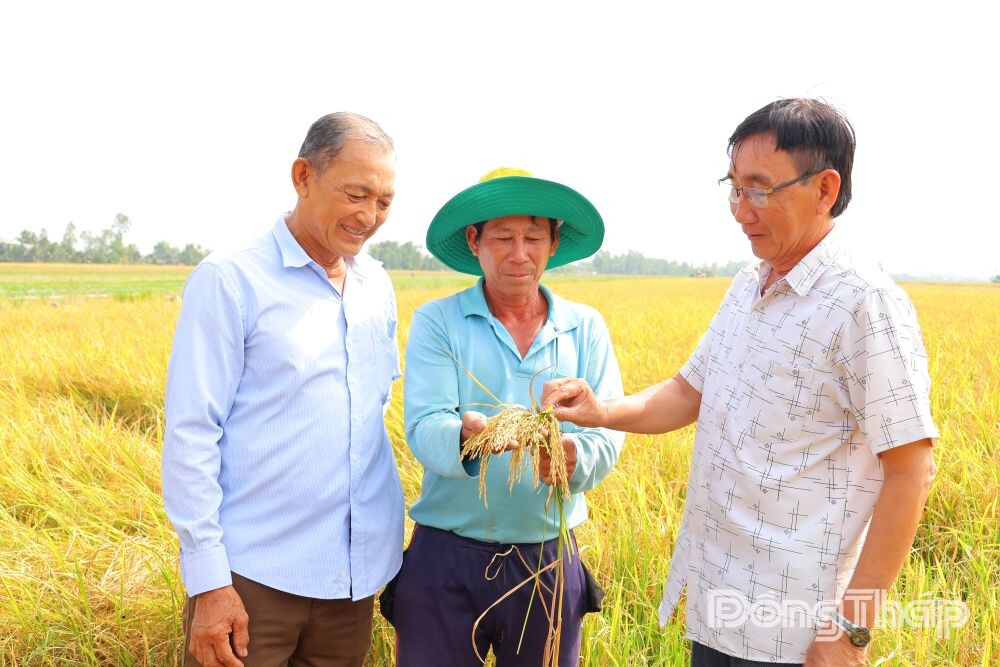
It is commonly referred to by locals as the “rice-crane” model. Changes in farming practices have helped reduce input costs while securing stable buyers, giving farmers greater confidence in a more sustainable production pathway.
Across the 171-hectare field managed by the Phu Xuan Agricultural Service Cooperative, harvest activities are in full swing. This is the eighth crop in which local farmers have taken part in the “rice-crane” model, located in the buffer zone of Tram Chim National Park.
This winter-spring season, yields in the model range from 8 to 8.5 tons per hectare, significantly higher than conventional fields. After deducting costs, farmers earn profits of 20-25 million VND per hectare, an increase of 5-8 million VND compared to fields outside the model.
Le Thanh Nguyen, a farmer in Phu Xuan Hamlet, Tam Nong Commune, said: “Previously, rice production costs were quite high because we used large amounts of seed, fertilizers, and pesticides. After joining the model, we were guided to adjust our farming practices, which significantly cut expenses and raised profits compared to the old way of growing rice.”
Another factor reassuring farmers is the participation of a corporate partner. All rice areas under the model are contracted from the start of the season with Mekong Food, which buys fresh rice directly in the field at the market rate of 5,800 VND per kilo plus an additional 200 VND per kilo.
Before purchase, samples are tested to ensure no pesticide residue. Harvested rice is transported to a drying facility within 12 hours to maintain grain quality.
Nguyen Thanh Hung, a technical officer for the model, explained: “The ecological rice farming process is designed to reduce emissions and ensure food safety. At the start of each crop, farmers receive training on how to minimize pesticide residues, avoiding any unnecessary active ingredients. During harvest, the company weighs the rice directly in the field and sends it for drying within a short time to ensure the grain meets export standards.”
Nguyen Van Hung, Director of the Phu Xuan Agricultural Service Cooperative, said: “After eight seasons, the model has drawn growing interest from farmers in the area. Seeing the results, many neighboring households now want to join. With a company committed to purchasing from the start of the crop, farmers can produce with greater confidence instead of worrying about market outlets as before.”
In 2026, Tam Nong Commune plans to expand the model to 271 hectares, with a target of reaching around 500 hectares by 2030.
The experience of Tam Nong farmers shows that in a volatile rice market, reducing production costs, improving product quality, and establishing linkages with enterprises are essential steps.
y MY LY - HG
Translated by ANH DUC