
Ensuring Capital for the 1-Million-Hectare High-Quality Rice Project
(DTO) On the morning of March 17, the Dong Thap Department of Agriculture and Environment, in coordination with the State Bank of Vietnam (Regional Branch 13), held a working session to survey and evaluate the implementation of the lending program for the "Sustainable Development of One Million Hectares of High-Quality, Low-Emission Rice in the Mekong Delta" project (the Project) in Truong Xuan and Doc Binh Kieu communes.
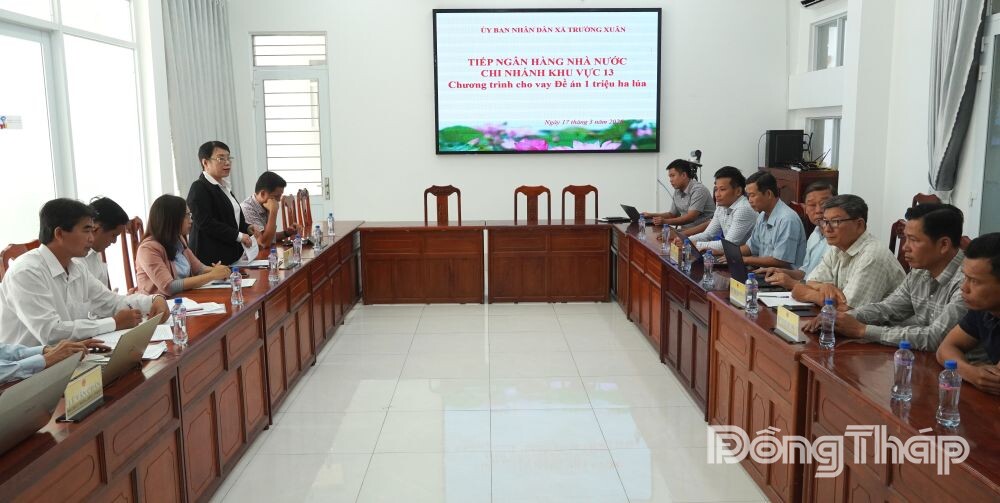
At the meeting, representatives of Truong Thanh Cooperative, Truong Phat Cooperative and Vietnam Rice Co., Ltd. (Truong Xuan Commune), along with Chon Chinh Import-Export Company (Doc Binh Kieu Commune), raised a number of issues related to production under the Project.
Notably, the demand for capital to invest in high-quality rice production remains substantial, particularly for machinery, agricultural inputs and building production–consumption linkages. However, cooperatives and farmers in Truong Xuan Commune still face difficulties in accessing loan capital while implementing the Project. They therefore proposed that the banking sector provide clearer guidance and support on loan procedures and conditions to facilitate access to credit.
A representative of Agribank Vietnam, Dong Thap Branch, said that the bank has proactively balanced capital sources and reduced costs to offer lending interest rates at least 1% per year lower than usual for this credit package. In addition, farmers and cooperatives can access other loan packages in accordance with banking regulations to meet their needs for production, machinery investment and expansion. The bank also provides consultation and guidance on lending conditions, procedures and documentation, while addressing difficulties encountered in accessing preferential credit during the implementation of the Project.
According to Ms. Le Thi My Hien, Deputy Director of the State Bank of Vietnam, Region 13 Branch, feedback from cooperatives, farmers and local authorities offers valuable practical insights for the working group in assessing the implementation of the credit program.
Based on this, relevant units will continue coordinating with departments, sectors and localities to develop solutions to remove bottlenecks and create more favorable conditions for stakeholders to access capital.
She also emphasized the need for continued coordination between the Department of Agriculture and Environment, local authorities and the banking sector, along with strengthened communication and guidance so that farmers and cooperatives clearly understand the benefits of participating in the Project, while promoting production linkages between farmers and enterprises.
By Nam Phong
Translated by X.QUANG