

Go Thap Festival: A Source of Pride in Dong Thap’s Cultural Heritage
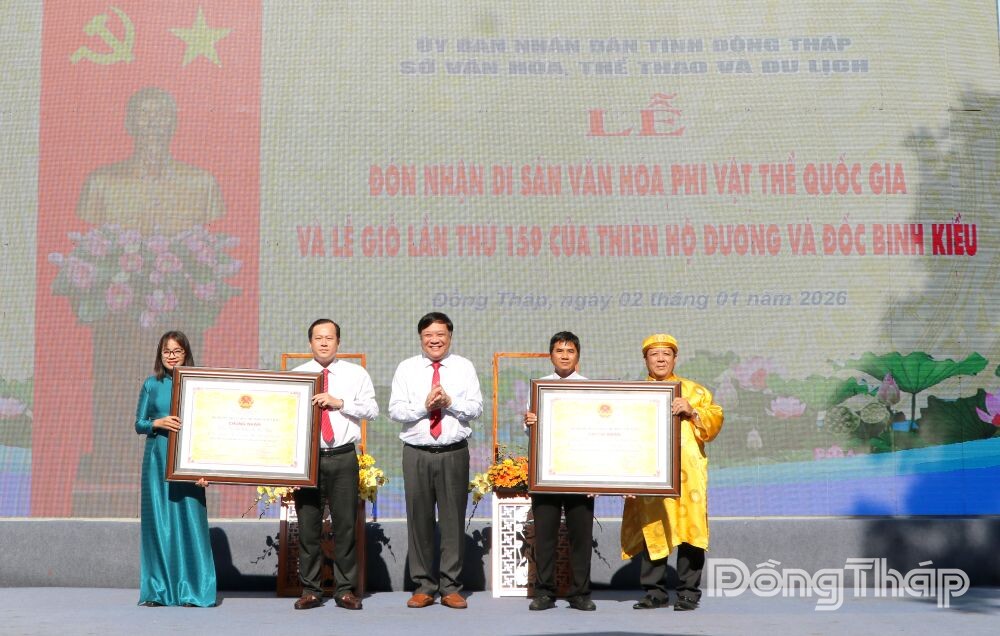
(DTO) In the middle of the eleventh lunar month, the Go Thap Special National Relic Site in Doc Binh Kieu Commune hosts an important cultural event: the death anniversary of Thien Ho Duong and Doc Binh Kieu, and the Via Ba Chua Xu of Go Thap Festival, now officially inscribed by the Ministry of Culture, Sports and Tourism into the National Intangible Cultural Heritage List.
This recognition is not only a source of pride for the Party Committee, authorities, and people of Dong Thap, but also a worthy acknowledgment by the Party and State of one of the province’s most significant cultural heritages.
A DISTINCTIVE AND ENDURING FESTIVAL
Every year, the Go Thap Special National Relic Site hosts two traditional festivals: the Via Ba Chua Xu of Go Thap Festival (14th-16th of the third lunar month), and the death anniversary of Thien Ho Duong and Doc Binh Kieu (14th-16th of the eleventh lunar month), celebrated solemnly.
According to the heritage dossier submitted for inclusion in the National Intangible Cultural Heritage List, the worship of Ba Chua Xu of Go Thap stems from the long-standing worship of Ba Chua Xu (Lady of the Realm), which originates from the worship of female deities associated with Vietnam’s wet-rice agricultural culture. This belief was preserved and developed during the southward expansion.
Dong Thap was one of the earliest areas settled by Vietnamese migrants and has long maintained multi-faceted exchanges with other provinces of the Mekong Delta, a region rich in folk beliefs, especially the worship of Mother Goddesses, with the veneration of Ba Chua Xu being one of the most prominent.
It is unclear when the worship of Ba Chua Xu of Go Thap first began. Local accounts say that in 1914, residents built a small shrine of light materials to worship her, but it was later destroyed during wartime.
In 1973, the shrine was rebuilt in simple form on its original foundation. After several relocations and restorations, the current shrine, now solemn and firmly constructed, was established in 1996 at its present location.
Thien Ho Duong, whose given name was Vo Duy Duong, was born in Binh Dinh (1827-1866). Doc Binh Kieu (year of birth unknown, died in 1866), also known as Le Cong Kieu, Tran Phu Kieu, or Nguyen Tan Kieu, was originally from the Central region and later settled in Kien Dang District, Dinh Tuong Province.
In the late 19th and early 20th centuries, Go Thap in Dong Thap Province was known as the “stronghold” of the resistance against French colonialists, led by national heroes such as Thien Ho Duong and Doc Binh Kieu.
They rallied the spirit of patriotism, placed the people at the core of their cause, and left behind a shining example of the nation’s steadfastness and indomitable spirit.
Guided by the belief that “in life they are generals, in death they become guardians,” the people built memorial temples at Go Thap after the two heroes passed away, preserving the worship rituals and death anniversary for more than 150 years.
These two festivals foster community cohesion and have evolved into traditional events that grow in scale every year.
The festivals follow traditional folk belief rituals, embodying the Vietnamese tradition of gratitude, paying tribute to the ancestors’ great contributions in the struggle against foreign invaders to protect the nation.
Alongside the rituals, each festival includes not only cultural and sports activities, but also charitable initiatives.
Motivated by the belief that doing good brings goodness in return, many individuals come to Go Thap every year during the festivals to join hands in volunteer work: helping prepare offerings such as wrapping cakes and arranging flowers for ancestral worship, cooking meals and boiling water to serve the thousands of festival-goers.
Ms. Nguyen Thi My Dung, a resident of Hamlet 5 in Truong Xuan Commune, shared: “Every year during the death anniversary of Thien Ho Duong and Doc Binh Kieu or the Via Ba Chua Xu of Go Thap Festival, I come to help with tasks like cooking and handing out water for visitors.”
Similarly, Mr. Tran Thi Kim Hoa from My Duc Commune, An Giang Province, said: “This year, I came to help cook meals for visitors from near and far attending the death anniversary of Thien Ho Duong and Doc Binh Kieu. Although the work is tiring, I feel truly happy and fulfilled knowing I’m contributing to something meaningful for the community.”
These community-driven activities have become a spiritual and cultural tradition deeply embedded in the consciousness of both locals and visitors. It is precisely this distinctive spiritual culture that has made the Go Thap Festival exceptional and allowed it to endure through generations.
PRIDE IN A CULTURAL HERITAGE
At Go Thap, locals and visitors can explore remarkable cultural heritage sites such as the Shrine of Ba Chua Xu, the Temple of Thien Ho Duong and Doc Binh Kieu, Thap Linh Pagoda, and more, each holding unique archaeological, architectural, and artistic value.
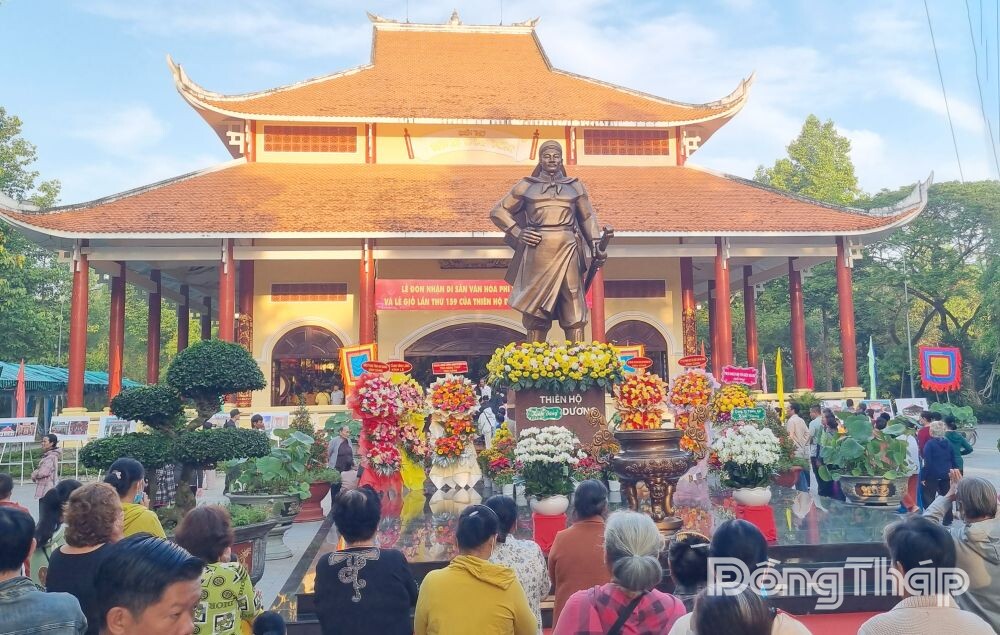
They can also immerse themselves in the sacred spiritual atmosphere of a land that preserves the legacy of national heroes, where the patriotism, resilience, and strategic brilliance of Thien Ho Duong and Doc Binh Kieu continue to resonate.
During the festival, visitors come seeking moments of peace and reflection, placing their hopes and wishes before joining in community activities.
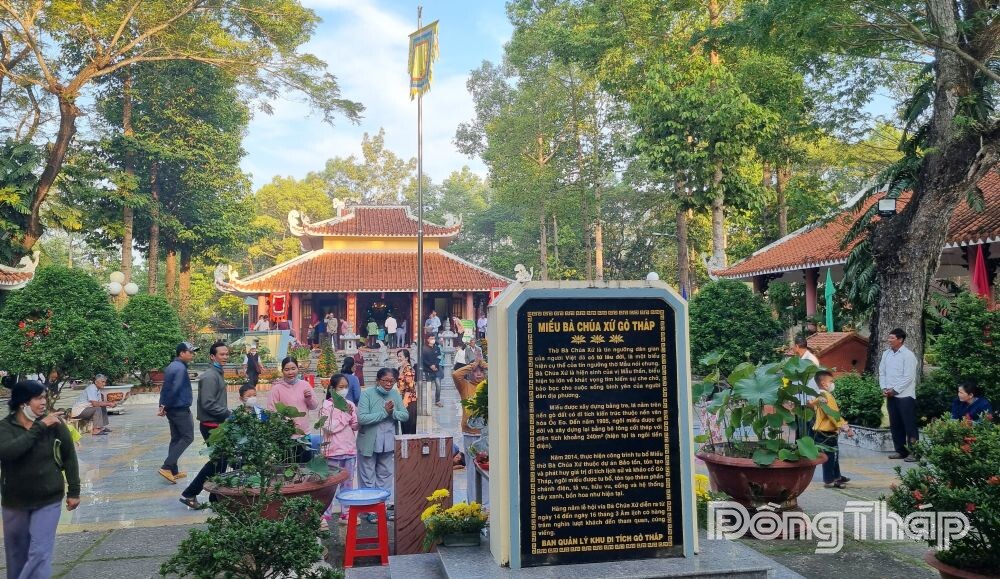
These historical and cultural values will endure, becoming a lasting source of pride for the people and future generations of Dong Thap.
Notably, on June 27, 2025, the Minister of Culture, Sports and Tourism officially inscribed the death anniversary of Thien Ho Duong and Doc Binh Kieu, along with the Via Ba Chua Xu of Go Thap Festival, into the National Intangible Cultural Heritage List.
Deputy Head of the Provincial Relic Site Management Board, Le Dinh Lang shared: “The inclusion of the death anniversary of Thien Ho Duong and Doc Binh Kieu, and the Via Ba Chua Xu of Go Thap Festival into the National Intangible Cultural Heritage List is profoundly meaningful. It is a source of pride for the Go Thap Special National Relic Site, for local residents, and for Dong Thap Province as a whole. This recognition affirms the cultural values that have been preserved and recognized.”
Mr. Pham Van Tai, a resident of My Quy Commune, said: “Every year during the Go Thap Festival, I come to pay my respects and help serve drinking water to visitors attending the events.
This year’s death anniversary of Thien Ho Duong and Doc Binh Kieu is even more meaningful as the relic site hosts the ceremony to recognize it as a National Intangible Cultural Heritage.
I hope that local authorities will continue to safeguard and uphold the significance of the death anniversary of Thien Ho Duong and Doc Binh Kieu, as well as the Via Ba Chua Xu of Go Thap Festival, so that future generations may understand, cherish, and preserve these traditions.”
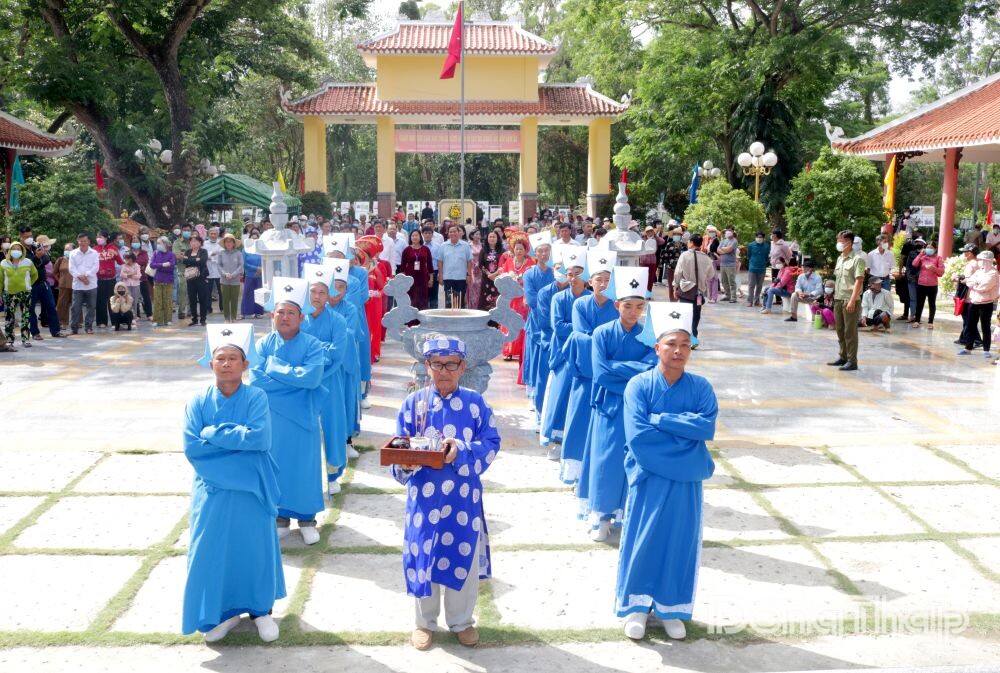
Alongside pride comes a great responsibility to preserve and promote the heritage’s values, ensuring it becomes a spiritual resource and a driving force for sustainable development.
Carrying forward this tradition and pride, the Provincial Relic Site Management Board, local authorities, and the Department of Culture, Sports and Tourism are working to preserve, enhance, and promote the value of the death anniversary of Thien Ho Duong and Doc Binh Kieu and the Via Ba Chua Xu of Go Thap Festival. Through these efforts, cultural values are preserved, the tradition of gratitude is upheld, and the contributions of past generations are honored, while also strengthening historical education and fostering patriotism and national pride among the youth.
Vice Chairman of the Provincial People’s Committee Huynh Minh Tuan stated: “The Provincial People’s Committee requests that local authorities continue to fulfill their responsibilities in state management of heritage, and create conditions for the community to participate broadly in the preservation and promotion of heritage values.
The Department of Culture, Sports and Tourism must proactively develop solutions to improve the quality of festival organization, linking heritage preservation with sustainable tourism development.
Meanwhile, the Go Thap Worship Committee should continue to pass on these traditions, maintaining its core role in safeguarding and spreading cultural values so they will be inherited and flourish.”
By MY XUYEN
Translated by ANH DUC