
Provincial Party Secretary Ngo Chi Cuong surveyd irrigation infrastructure in Dong Thap’s eastern region
(DTO) On the morning of May 7, a working delegation led by Mr. Ngo Chi Cuong, Member of the Party Central Committee, Secretary of the Provincial Party Committee and Chairman of the provincial People’s Council, conducted a field survey of irrigation and water supply infrastructure in the eastern area of Dong Thap. Joining the delegation was Mr. Nguyen Thanh Dieu, Vice Chairman of the provincial People’s Committee.
The delegation inspected several key locations, including the Xuan Hoa sluice gate in Binh Ninh Commune — the main water intake structure of the Go Cong freshwater zone; the Binh Phan pumping station in An Thanh Thuy Commune; the Tan Thuan Binh sluice gate and the proposed siphon cluster crossing the Cho Gao Canal in An Thanh Thuy and Tan Thuan Binh communes; the Go Cong Water Plant and booster pumping station in Binh Xuan Ward; and the Go Gua sluice gate in Phu Thanh Commune.
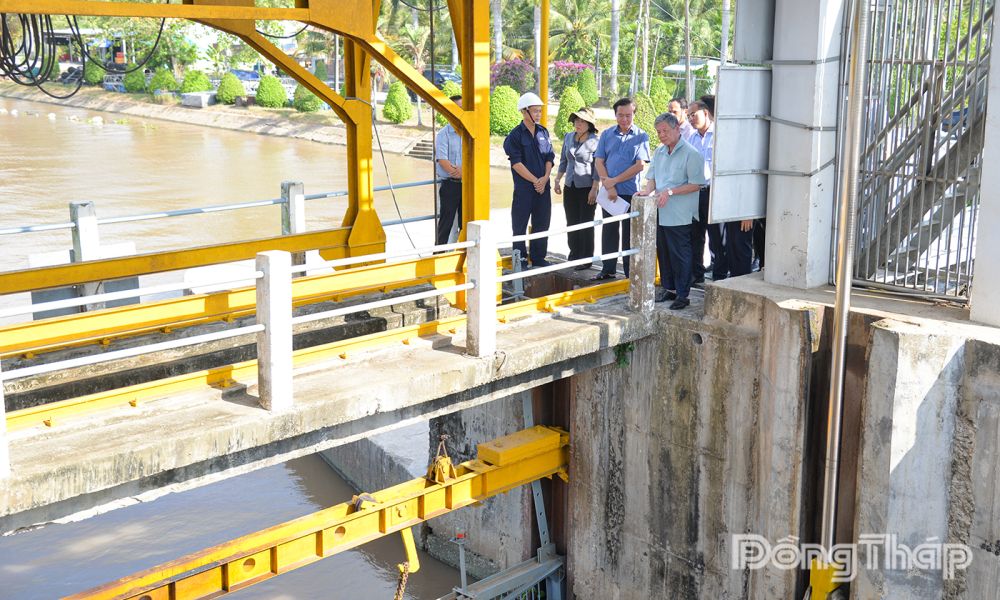
After more than 50 years of investment from various funding sources, the irrigation system has gradually been completed, forming an integrated and closed network of major works, including regulating sluice gates, water conveyance canal networks, sea dikes and river dikes.
The system has basically met water control requirements, helping prevent drought and saltwater intrusion across approximately 44,000 hectares of agricultural land.
In addition, the irrigation network plays an essential infrastructure role in supporting socio-economic development, particularly for industrial parks and clusters such as Binh Dong, Gia Thuan and the Soai Rap Petroleum Service Industrial Park, as well as expanding space for future urban, service and coastal tourism development.
However, due to the coastal location and the freshwater supply connection between the province and the project area being separated by the Cho Gao Canal, the region often lacks supplementary freshwater toward the end of the dry season, particularly when saltwater intrusion surpasses the Xuan Hoa sluice gate, posing risks to both production and daily life.
Currently, freshwater for the Go Cong freshwater zone is mainly supplied through the Xuan Hoa sluice gate and distributed via major canal routes, including the Xuan Hoa – Cau Ngang Canal, Vam Giong Canal, Canal No.14, Tran Van Dong Canal, Salisette Canal, Son Qui – Lang Nua Creek and the inland canal network.
The operational efficiency of the Xuan Hoa sluice gate is heavily affected by hydraulic conditions and saltwater intrusion levels on the Tien River. As saltwater intrusion on the river tends to intensify and penetrate deeper inland, reaching approximately 60–70 kilometers to Kim Son Commune — more than 45 kilometers from the Go Cong system — saline water can surround the area for prolonged periods without freshwater replenishment, causing major impacts on production and people’s livelihoods despite proactive water storage measures implemented within the Go Cong freshwater zone.
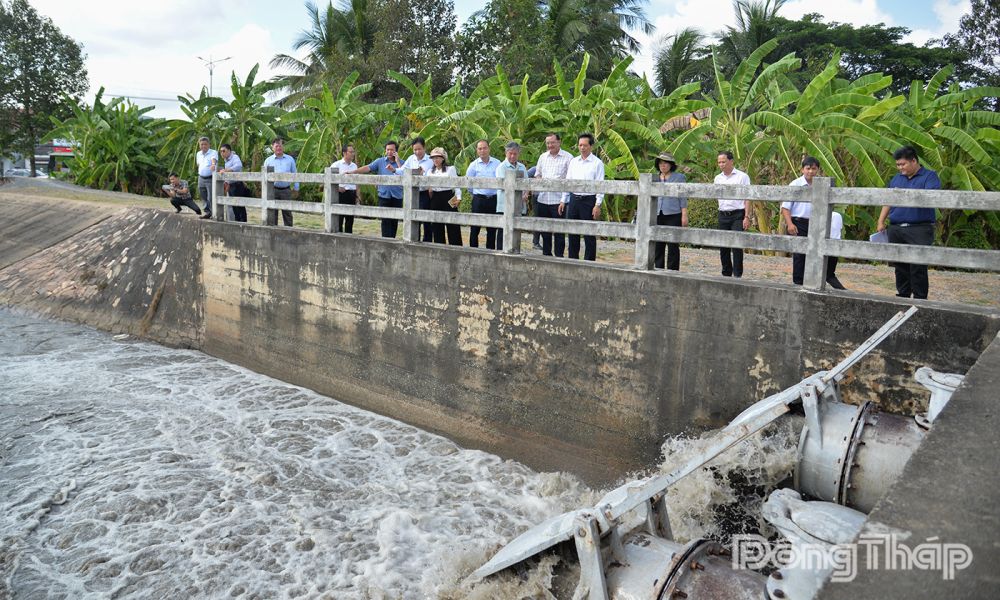
According to the provincial master plan to 2030, with a vision toward 2050, the Go Cong area must ensure water supply for agricultural production and daily use, while also serving nine industrial parks and clusters covering approximately 5,000 hectares, as well as urban, service and coastal tourism development. Total water demand is projected at around 300,000 cubic meters per day, while current supply capacity stands at only 100,000 cubic meters per day, meeting roughly one-third of the demand.
To ensure domestic and industrial water supply in line with socio-economic development orientations for the Go Cong freshwater zone, the implementation of the project to transfer freshwater across Cho Gao Canal will create a stable raw water source. This will facilitate investment in a new water supply plant with a capacity of 50,000–100,000 cubic meters per day, helping meet future demand.
According to studies and assessments by the agricultural sector, in order to secure a stable raw water source for domestic, industrial and production use during the dry season, further research is needed to develop water storage systems at Go Gua and Ram Ve, located in Vinh Binh Commune, Phu Thanh Commune and Binh Xuan Ward.
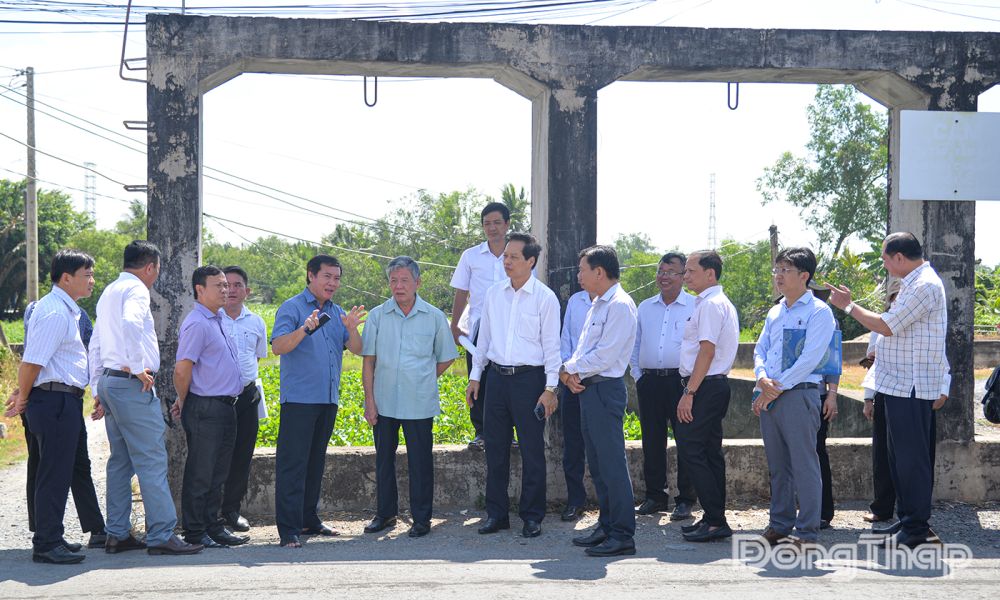
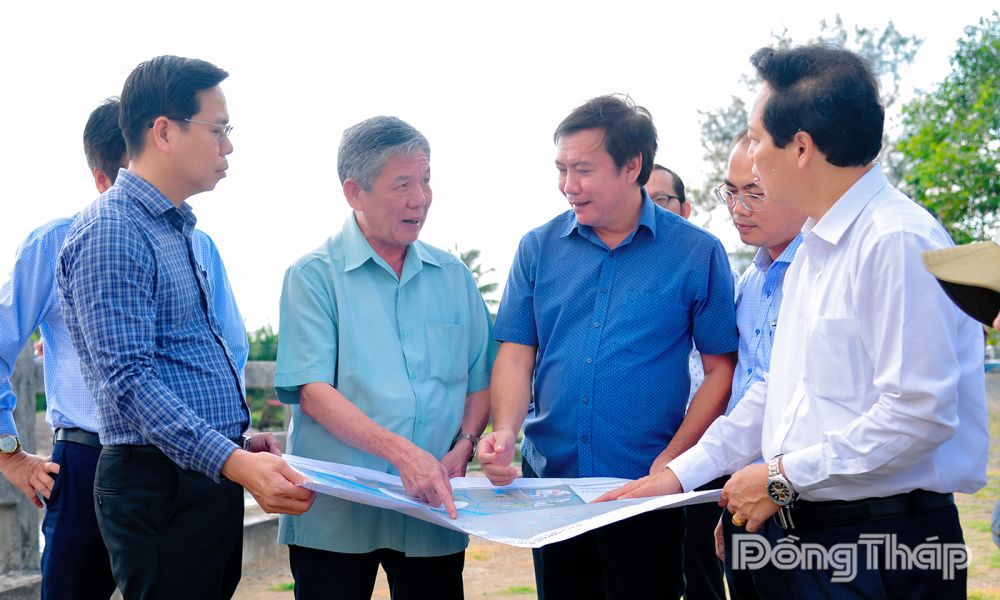
Following the field survey, Provincial Party Secretary Ngo Chi Cuong proposed that, regarding the orientation for implementing the freshwater transfer project across Cho Gao Canal to supply the Go Cong freshwater zone, priority should first be given to dredging and clearing water flows to ensure immediate supply needs.
Party Secretary Ngo Chi Cuong stressed that long-term planning must ensure sufficient water supply to meet both industrial development and future demand. The current priority is to invest in siphon systems and large-capacity transmission pipelines to maintain stable water flows, replacing natural gravity flow where conditions are no longer favorable. Technical solutions must be carefully studied with contingency plans, including the possibility of developing additional direct routes to avoid areas at risk of pollution or restricted water flow.
During implementation, the project should maximize and synchronously connect with existing infrastructure such as sluice gate systems, pipelines and regulating works currently in operation, while also preparing response plans for extreme weather conditions, saltwater intrusion or situations requiring the closure of regulating sluice gates.
The project is of great significance for industrial development, people’s livelihoods and water resource security. Relevant agencies and units were therefore urged to continue reviewing and finalizing technical plans, assess investment efficiency and soon propose policies for implementation.
By Ha Nam
Translated by X.QUANG