
Rallying collective action to curb plastic waste
(DTO) In recent years, in line with nationwide efforts, Dong Thap province has implemented a suite of coordinated measures to control and mitigate plastic pollution. From central-level policies to grassroots initiatives, the “Say no to single-use plastics” movement is steadily taking root in everyday life.
However, to ensure a sustainable shift, the decisive factor lies in transforming individual habits alongside the replication of practical and effective models
SOUND POLICIES, COORDINATED ACTION
Implementing Directive No. 33/CT-TTg issued by the Prime Minister on strengthening the management and reduction of plastic waste, Dong Thap has translated the policy into practical programmes and plans tailored to local conditions.
The provincial Department of Agriculture and Environment plays a core role, working closely with departments, sectors and mass organisations to widely implement campaigns such as “Combating plastic waste” and “All people join hands to protect the environment”, while strengthening solid waste management.
Communication activities have been carried out regularly in diverse formats, associated with environmental events such as World Environment Day (June 5) and the Action Month for the Environment.
These efforts have gradually raised awareness among officials, Party members and the public about the harmful impacts of plastic waste, translating awareness into concrete actions.
Beyond communication, many localities have proactively developed plans and integrated plastic waste reduction into socio-economic development programmes, new-style rural building and urban civilisation initiatives. This serves as an important foundation for ensuring the movement delivers substantive and sustainable outcomes rather than remaining superficial.
One of Dong Thap’s highlights is the effective mobilisation of socio-political organisations in developing and scaling up community-based models to reduce plastic waste.
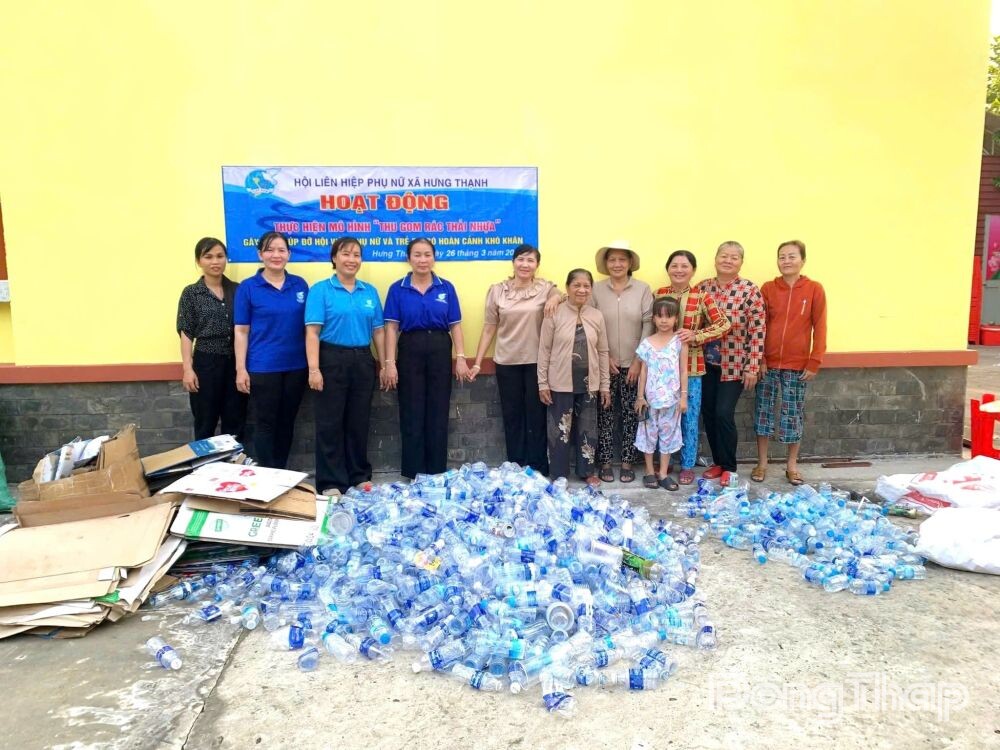
The Women’s Union at all levels has continued to affirm its pioneering role, with nearly 500 clubs promoting initiatives such as “Women limiting the use of single-use plastic products” and “Women reducing the use of plastic bags.”
These models go beyond awareness-raising to include practical activities such as collecting, sorting and recycling plastic waste, while generating funds to support disadvantaged members.
In many localities, the “Green House” model initiated by the Women’s Union has proven effective. Collection points for recyclable waste are set up in residential areas, schools and offices, helping foster waste separation at source while raising funds from recyclables to support social welfare activities.
In Tan Thuan Binh commune, all Women’s Union branches have established clubs to limit plastic use.
Chairwoman of the commune’s Women’s Union Dang Thi Thuy Trang, said that on average each year, club members organise between 15 and 20 collection drives, gathering tonnes of recyclable plastic waste. They also actively conduct communication activities to raise public awareness about combating plastic waste.
In rural areas, the Farmers’ Union has maintained models such as “Plastic waste-free fields” and “Collection of used pesticide packaging”. Many localities have installed collection tanks in fields for pesticide containers, helping curb indiscriminate disposal and reduce environmental pollution.
The Ho Chi Minh Communist Youth Union has actively engaged young people and residents through initiatives such as “Green Sunday” and “Exchanging plastic waste for plants or essential goods.” These activities not only help clean up the environment but also spread messages of green living and sustainable consumption.
Identifying education and communication as long-term foundations, Dong Thap has integrated “Combating plastic waste” content into 100 per cent of schools across the province. Models such as “Plastic waste-free schools”, “Turning waste into gifts”, “Waste-for-gifts exchange corners” and the “Small Plan” initiative have been effectively implemented, helping students develop environmental awareness from an early age. |
Many schools have proactively replaced plastic cups and straws with environmentally friendly alternatives, while encouraging students to use personal water bottles. Though small, these changes play a significant role in shaping sustainable consumption habits.
Educating students is considered the most effective way to create lasting change, as their awareness can influence their families and gradually spread throughout the community.
Local media agencies have also intensified communication efforts, developing dedicated columns and features on environmental protection and promoting effective models and good practices, thereby helping to shift public awareness and behaviour in a positive direction.
AIMING FOR GREEN GROWTH
Notably, these initiatives have gone beyond campaigns, receiving strong support from local communities.
In many residential areas, it has become increasingly common to see people bringing reusable bags to markets, using personal water bottles and limiting single-use plastics.
Many households have taken the initiative to sort waste at source and reuse organic waste as fertiliser, helping reduce environmental pollution.
Ms. Nguyen Thi Lan, a resident of Cho Gao commune, shared: “In the past, I used a lot of plastic bags when going to the market, but now I’ve switched to cloth bags. At first it felt inconvenient, but over time it became a habit. Knowing that I’m contributing to environmental protection makes me very happy.”
Not only in
Several localities have also introduced the “Traditional markets reducing plastic waste” model, encouraging vendors to use environmentally friendly packaging and limit plastic bags. Shoppers are gradually forming the habit of bringing their own baskets or reusable bags, significantly reducing the amount of plastic waste generated each day. |
dividuals, but also many businesses, eateries and coffee shops have begun to change their practices by using paper straws, glass cups or other eco-friendly materials, contributing to the spread of a green lifestyle.
Under its development orientation for 2025–2030, Dong Thap aims to achieve rapid yet sustainable growth associated with environmental protection and climate change adaptation, in which reducing plastic waste is identified as a key task.
To this end, the province will continue promoting waste separation at source, encouraging reuse and recycling, supporting circular economy models, and strengthening inspection and supervision of environmental protection regulations.
At the same time, efforts will focus on scaling up effective grassroots models such as “Plastic waste-free residential areas”, “Green – clean – beautiful roads”, “Green offices” and “Green markets”, while promptly commending organisations and individuals with innovative and effective initiatives.
In practice, all policies and guidelines can only be effective with public consensus and active participation. Reducing plastic waste does not require grand actions, but begins with simple, everyday habits.
Each individual can contribute by bringing reusable bags when shopping, using personal water bottles, limiting single-use plastics, sorting waste at source and prioritising environmentally friendly products. When these actions become routine, they collectively create a powerful force in protecting the living environment.
With the determination of the entire political system and the active engagement of the community, Dong Thap is steadily building a green, clean and beautiful living environment, moving towards sustainable development for the well-being of both present and future generations.
By SOM MAI
Translated by X.QUANG