
MR. NGUYEN NGOC BACH:
Sustainable Aquaculture Adapted to Market Trends and Climate Change
(DTO) Amid mounting challenges facing the aquaculture sector, including climate change, disease outbreaks, and increasingly stringent market requirements, the clean aquaculture model with strict antibiotic control developed by Nguyen Ngoc Bach (born 1987), a resident of Hamlet 2B, Binh Hang Trung Commune, has proven to be well suited to current conditions and shows strong potential for wider replication in production.
CLEAN FARMING – AN INEVITABLE REQUIREMENT
After graduating with a degree in aquaculture engineering, Mr. Nguyen Ngoc Bach worked for several aquatic feed manufacturing companies.

In 2008, he returned to his hometown to continue his family’s traditional aquaculture activities, raising snakehead fish, climbing perch, catfish, and frogs.
During the early stage, his farming operation remained relatively stable, with frog farming in particular generating good income.
However, over time, the limitations of the traditional model became increasingly apparent: declining seed quality, frequent disease outbreaks, rising costs of medicine and antibiotics, and unstable selling prices.
More concerning was the heavy dependence on antibiotics, which made it difficult for products to meet the market’s increasingly strict quality requirements.
These realities made it clear that a shift in production methods was necessary to sustain aquaculture in a long-term, safe, and efficient manner.
In 2025, Bach decided to transition from traditional earthen ponds to a clean aquaculture model, focusing on strict control of antibiotics and farming environments.
Instead of high-density farming in soil ponds, Mr. Bach invested in a system of concrete tanks and restructured the entire technical process.
According to Mr. Bach, the key to the new model lies in reducing stocking density and combining it with a circulating water system and frequent water exchange, ensuring a clean environment and minimizing disease risks.
In addition, settling ponds and probiotic products are used to treat water, helping to reduce pollution and negative impacts on the surrounding environment.
ADAPTING TO NEW PRODUCTION CONDITIONS
This approach enables aquatic species to grow more favorably, remain healthier, and significantly reduces the use of medicines and antibiotics throughout the farming cycle—an especially important factor as climate change makes aquatic diseases increasingly difficult to control.

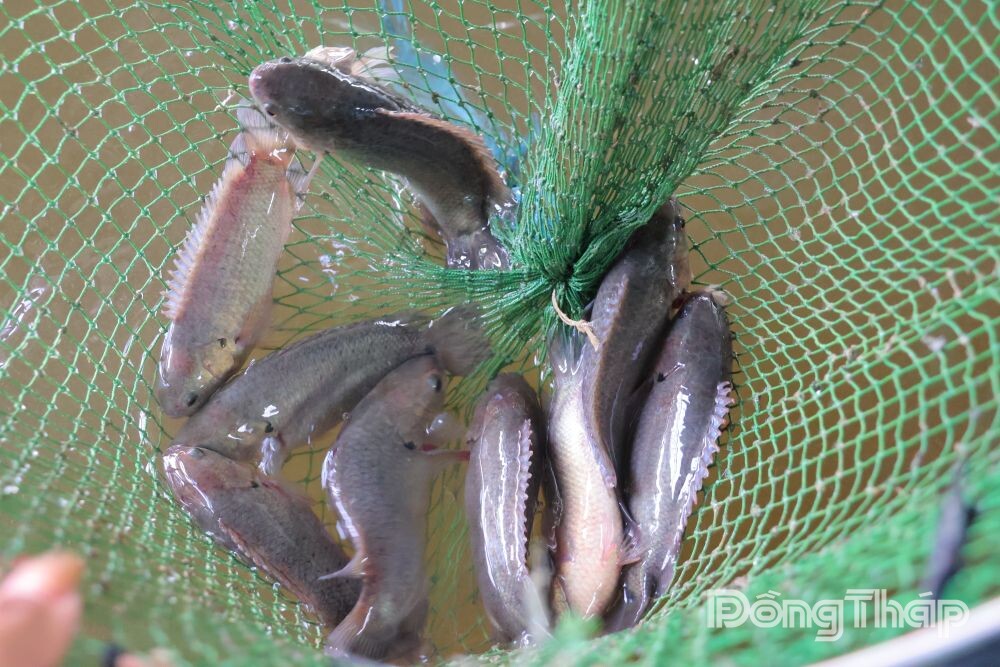
After the first production cycles, the new model delivered positive economic results. Currently, Mr. Bach raises snakehead fish, climbing perch, catfish, and fingerlings for the market.
Compared to traditional methods, the clean farming model helps reduce production costs by about 20 percent, mainly due to savings on medicines, antibiotics, and labor.
Notably, products raised under strict antibiotic control are sampled and tested by partner enterprises at the end of each cycle.
If quality standards are met, products are purchased at prices 4,000–5,000 VND per kilogram higher than those from conventional farming. As a result, profits increase by approximately 20 percent while production risks are significantly reduced.
Beyond economic benefits, Bach believes the new model also brings long-term health advantages for farmers.
“Following clean farming procedures means less exposure to chemicals and antibiotics, and a safer working environment. Only when farmers stay healthy can they remain committed to agriculture in the long run,” he shared.
As consumers become increasingly concerned about food safety and health, demand for clean aquaculture products free from antibiotic residues is rising rapidly.
This is a major advantage of the strict antibiotic-control model that Mr. Bach is implementing.
At the same time, climate change—with unpredictable impacts on weather, water sources, and disease patterns—has exposed many risks in traditional farming models.
Reducing stocking density, proactively managing water quality, and using probiotics instead of antibiotics make Mr. Bach’s model more resilient to adverse weather conditions while also reducing environmental pollution.
In the coming period, Mr. Bach plans to cooperate with other farming households in the area to expand the farming zone and ensure stable output for purchasing enterprises. This is also a necessary step toward forming a safe aquaculture production area that meets the market’s growing demands.
Binh Hang Trung is a locality with a relatively large freshwater aquaculture area and was once considered a key aquaculture zone of the former Cao Lanh District.
Alongside rice and fruit trees, aquaculture has been identified as an important sector in the commune’s agricultural economic structure.
According to the orientation of the Binh Hang Trung Commune People’s Committee, the locality will continue to encourage the development of clean and sustainable aquaculture models linked to environmental control and market connectivity.
Nguyen Ngoc Bach’s model is considered well aligned with this direction and capable of being replicated among local farmers.
Practical experience from Nguyễn Ngọc Bach’s model shows that shifting to clean farming with strict antibiotic control is not merely a short-term solution, but a long-term pathway for the aquaculture sector amid market volatility and increasingly evident climate change.
It is also a concrete contribution to building a sustainable agricultural foundation in Binh Hang Trung in the new development phase.
By MY LY
Translated by X.QUANG