
Tam Nong: The One-Million-Hectare Rice Project and a Paradigm Shift in Farming Mindset
(DTO) - Driven by the One-Million-Hectare High-Quality, Low-Emission Rice Project (abbreviated as the One-Million-Hectare Project), Tam Nong Commune is aiming to build a sustainable rice production area, enabling farmers to increase incomes while safeguarding land resources and the ecological environment of the Dong Thap Muoi (Plain of Reeds) region.
RESHAPING FARMING PRACTICES
Rice has been designated as the flagship sector of Tam Nong Commune. With approximately 6,012 hectares cultivated each crop season, an average yield of 7.5 tons per hectare, and an annual output exceeding 45,000 tons, this crop plays a vital role not only in agricultural development but also in the livelihoods of thousands of local households.
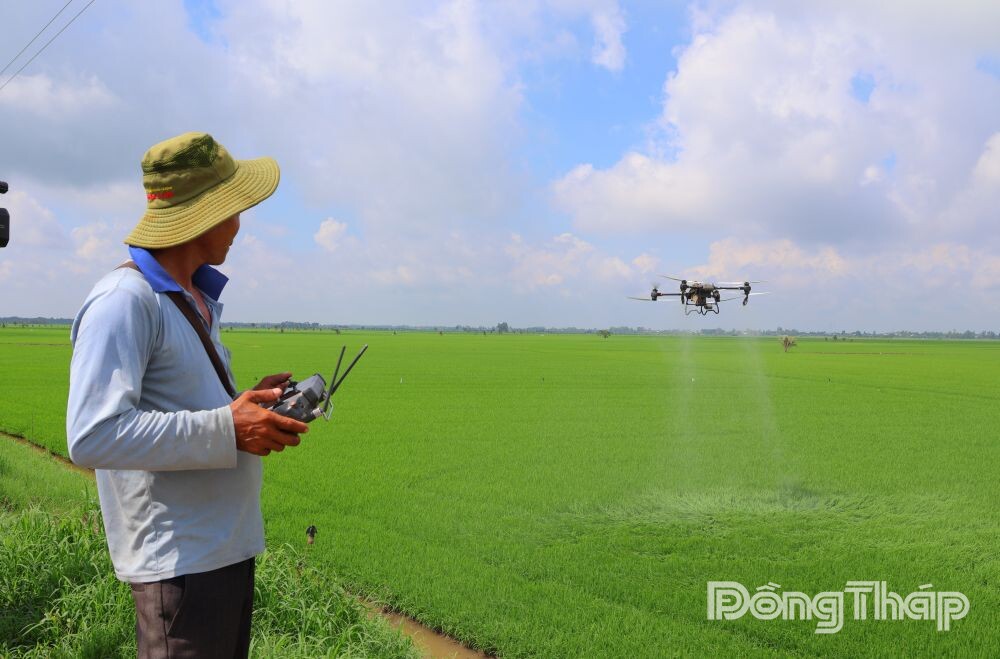
However, against the backdrop of increasingly visible climate change impacts, surging agricultural input prices, and unstable market prices, traditional farming practices have begun to reveal significant limitations.
Heavy reliance on multiple seed varieties, fertilizers, and chemical crop protection has driven production costs higher, while economic returns no longer meet farmers’ expectations.
In addition, the long-standing practice of burning rice straw after harvest generates substantial greenhouse gas emissions, harms the environment, and depletes the soil’s natural organic matter.
In response, and in line with agricultural restructuring goals, Tam Nong Commune has proactively coordinated with specialized sectors and cooperatives to implement the Project on Sustainable Development of One Million Hectares of High-Quality, Low-Emission Rice Associated with Green Growth in the Mekong Delta by 2030.
After four crop seasons underway, more than 1,143 hectares in the commune have joined the project. Among them, Tan Tien Agricultural Service Cooperative has emerged as a pioneer, with its entire production area of over 700 hectares transitioning to sustainable rice cultivation practices aligned with the project.
The application of the technical processes under the One-Million-Hectare Project at Tan Tien Agricultural Service Cooperative is driving positive changes in farmers' awareness. Through the synchronized implementation of the “One Must-Do, Five Reductions” approach—reducing seed rates to below 100 kilograms per hectare, cutting fertilizer and pesticide use by 30 percent, adopting alternate wetting and drying irrigation, and treating rice straw with micro-organic products—farmers have significantly lowered production costs amid rising input prices.
Calculations show that profits from this model have increased by approximately 30 to 40 percent compared to conventional farming methods. Farmers in Tam Nong are gradually altering their cultivation practices toward lower costs, lower emissions, and higher grain quality.
TOWARD GREEN AND SUSTAINABLE AGRICULTURE
Beyond improving economic efficiency, Tan Tien Agricultural Service Cooperative is also working to restore soil resources and promote environmentally friendly production.
The cooperative is collaborating with agricultural authorities to implement a model of burying rice straw back into the soil combined with microbial spraying to accelerate organic decomposition and return nutrients to the fields.
Mr. Mai Tan Tien, Chairman of the Board of Directors and Director of Tan Tien Cooperative, shared: “We believe that burying rice straw into the soil and applying microbial products will open up a new path for farmers, fundamentally changing cultivation practices and relieving cost pressures caused by market fluctuations. Once the benefits in restoring soil nutrients and reducing chemical fertilizer use are proven, this will provide a solid foundation for farmers to boldly move toward green and sustainable agriculture.”
According to the Tam Nong Communal People’s Committee, in addition to the One-Million-Hectare Project, the locality is also implementing an ecological rice production model combined with the conservation and development of red-crowned cranes at the Tram Chim National Park, spanning 171.5 hectares and involving 32 farming households.
This initiative demonstrates the commune’s efforts to integrate agricultural production with ecological development, environmental protection, and green growth.
Mr. Luu Van Tien, Vice Chairman of the Tam Nong Communal People’s Committee, said: “The commune's leadership emphasizes that the One-Million-Hectare Project aims not only at improving rice quality but also at reshaping farmers’ production mindset toward cost reduction, increasing economic efficiency, and adapting to climate change. In the coming period, the commune will continue working with cooperatives, technical agencies, and enterprises to expand the project area, step up the application of science and technology, and gradually build a high-quality rice production zone coupled with green and sustainable agricultural development.”
By MY LY – HG
Translated by X.QUANG