
Tram Chim Discusses Ecological Rice Development Linked to Product Consumption Partnerships
(DTO) – On June 15, the People's Committee of Tram Chim Commune, Dong Thap Province, partnered with businesses and specialized agencies to conduct a field assessment of the ecological rice production model in polder 43B. Concurrently, they hosted a seminar themed “Ecological Rice Production and Product Marketing Linkages.”
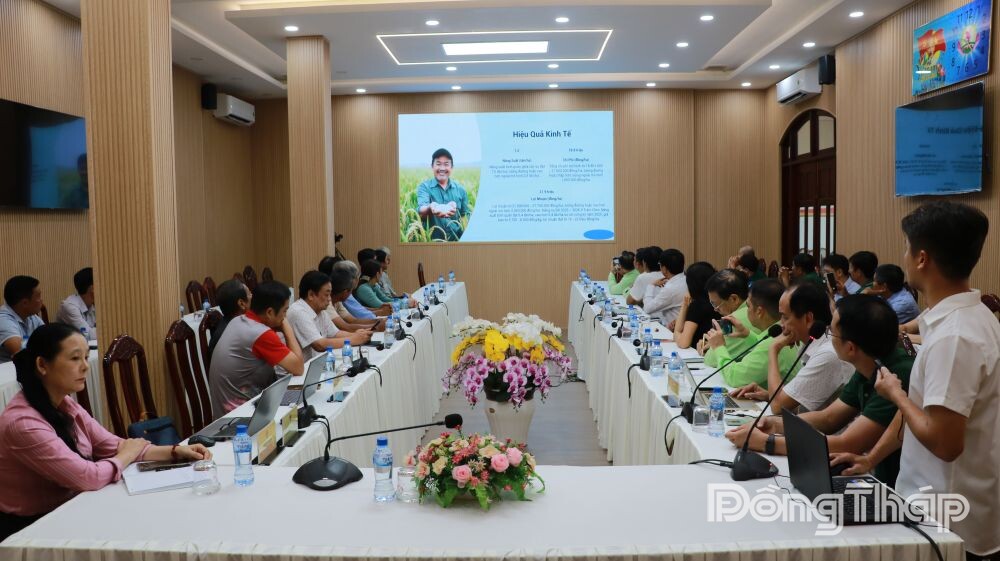
The event drew the attendance of Mr. Le Minh Hoan, former Vice Chairman of the National Assembly; representatives of VFC, VinaRice, PAN Group, Wildbird Tram Chim, and the Sub-Department of Crop Production and Plant Protection; leaders of Tram Chim and Tam Nong communes; along with experts, scientists, and numerous local rice farmers.
Prior to the seminar, a survey delegation comprising representatives of companies, businesses, specialized agencies, local authorities, and farmers conducted a field visit to polder 43B to assess the outcomes of the ecological rice production model.
During the visit, participants directly inspected cultivation practices, production efficiency, and the model’s adaptability to the natural conditions of the Tram Chim wetland region. They also discussed its potential for wider replication in the coming years.
At the seminar, the Tram Chim Commune People's Committee delivered a report on the rollout of the ecological rice production model in the area, focusing on cultivation area, participating households, current production processes, initial results, as well as challenges and obstacles encountered.
The locality also urged relevant agencies and businesses to continue providing support in techniques, seed supply, biological solutions, and marketing linkages to boost production efficiency for farmers.
Photo 2: Representatives of businesses, specialized agencies, local authorities, and farmers conduct a field survey in polder 43B to evaluate the ecological rice production model.
Sharing his experience at the seminar, farmer Bui Van Sang, a participant in the model, said that ecological farming practices help reduce the use of fertilizers and pesticides, lower production costs, gradually enhance rice quality, and protect the farming environment.
Speaking at the event, Mr. Le Minh Hoan shared orientations for cooperation in developing ecological rice production in the Tram Chim–Tam Nong area based on a balance between agricultural economic development and natural ecosystem conservation.
He emphasized that ecological rice production not only produces safe agricultural products and enhances the value of rice grains but also contributes to preserving the distinctive wetland ecosystem of Tram Chim.
To ensure sustainable development, a tight linkage among farmers, businesses, scientists, and local authorities is required throughout the entire production and consumption chain.
At the seminar, business representatives also expressed strong interest and pledged to accompany the locality by supporting cultivation techniques, applying biological solutions, developing raw material zones, and establishing product purchase agreements.
These commitments are regarded as an important foundation for expanding ecological rice cultivation, driving up farmers’ incomes, and gradually building the Tram Chim Ecological Rice brand in the years ahead.
By ANH KIET – MY LY
Translated by X. QUANG