
Ho Chi Minh’s Ideology and Ethics: Deeply Rooted in Daily Life
(DTO) The thought, morality, and style of President Ho Chi Minh constitute an invaluable spiritual legacy, serving as the ideological foundation of the Communist Party of Vietnam and the guiding compass for the nation’s revolutionary actions.
Over the years, "studying and following Uncle Ho’s example" has evolved from mere awareness into an intrinsic necessity for every cadre, Party member, and citizen, becoming deeply embedded in the fabric of daily life.
A "BREAKTHROUGH" IN THINKING
Immediately after President Ho Chi Minh’s passing on September 2, 1969, the Party launched the slogan: “Live, fight, work, and study following the great example of Uncle Ho.” This call to action spread rapidly, becoming a profound source of inspiration that fueled the nation’s historic victories.
Notably, throughout 40 years of Doi Moi (Renovation), this movement has been institutionalized through specific directives tailored to each stage of national development. While Directive 23 (2003) laid the groundwork for research, Directive 06 (2006) marked a pivotal shift by emphasizing "practice" (làm theo). This roadmap was further refined through Directives 03 and 05, creating a comprehensive framework for the entire Party, people, and armed forces.
Most significantly, Conclusion 01 (2021) signaled a qualitative breakthrough with a clear trajectory: “From studying to following; from following to setting examples; and from setting examples to voluntary, regular practice.” This is not merely an expansion of scope but a profound shift in the Party’s theoretical thinking. It has moved beyond a formal campaign to become an internalized need—deeply rooted in consciousness and lifestyle—serving as the moral benchmark for every Vietnamese citizen.
LEADING BY EXAMPLE: EMULATING UNCLE HO
Today, Dong Thap presents a vibrant landscape where studying and following the example of President Ho Chi Minh has become a familiar “rhythm of life.”
This spirit has evolved into an intrinsic need, deeply embedded in every task and thought, and closely intertwined with political missions, Party building, and the everyday grassroots concerns.
Under the flexible and methodical leadership of Party committees at all levels, the movement has been implemented with distinctive, signature approaches. Consequently, the mindset of “learning to know” has shifted toward “setting examples and taking practical action,” serving as the gold standard for the prestige and performance of every official and Party member.
Over time, creative “green shoots” have flourished across the province. Innovative models such as “Friendly Administration,” “Farmers’ Assembly Houses,” and “Compassionate Markets” are not merely political initiatives but bridges connecting the Party’s will with the people’s hearts.
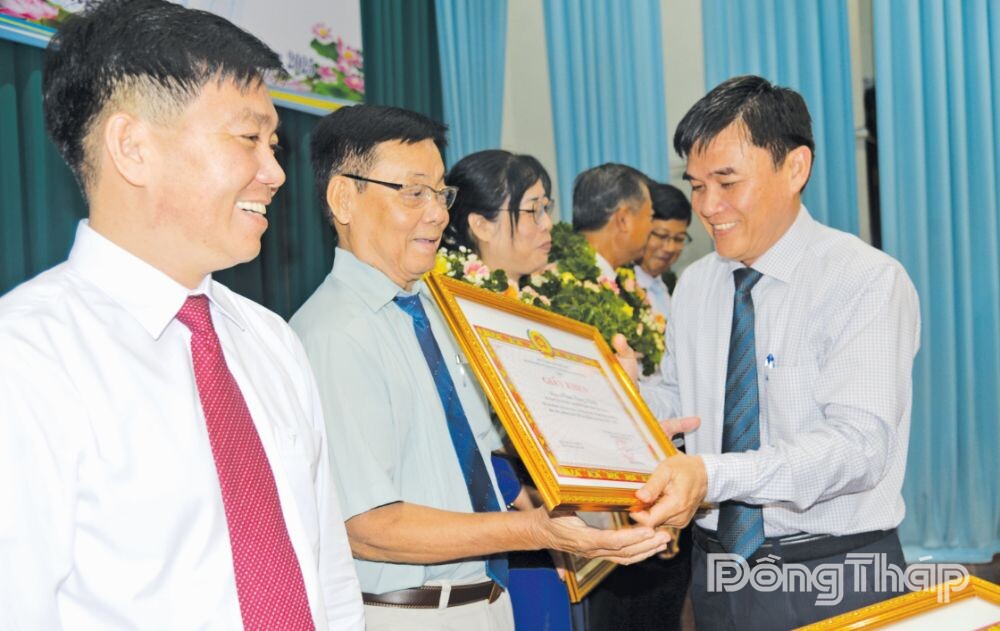
In social life, these values permeate daily activities. From charitable organizations to noble individual gestures, they have woven a deeply humane social fabric. Numerous exemplary collectives and individuals have emerged like vibrant flowers in the heart of the community.
According to the Dong Thap Provincial Party Committee’s Commission for Propaganda and Education and Commission for Mass Mobilization, the province commended 111 outstanding examples in 2025 and throughout the 2016–2025 period, fostering a powerful and widespread movement of “good people, good deeds.”
BUILDING A CULTURE OF INTEGRITY
From clear shifts in awareness to concrete action, the movement of studying and following Uncle Ho’s example in Dong Thap is shaping sustainable values. The spirit of exemplarity, responsibility, and dedication has become the cornerstone of conduct and public service execution.
Building a culture of integrity is an inevitable progression in realizing President Ho Chi Minh’s teaching: cadres and Party members must be “the most resolute, the most enthusiastic, the most upright, and wholeheartedly dedicated to serving the Fatherland and the People.”
Recently, the Standing Board of the Dong Thap Provincial Party Committee held a political-ideological session for 2026, focusing on: “Promoting Dong Thap’s cultural strength; upholding the responsibility of cadres; and building a culture of integrity in line with Ho Chi Minh’s ideology, morality, and style.”
In reality, building a culture of integrity is closely tied to daily work.
Ho Chi Minh’s ideology, morality, and style will forever remain a shining beacon, guiding the actions of every cadre, Party member, and citizen on the journey of development. Studying and following his moral example has become a vital driving force in building a clean and strong Party Committee, propelling Dong Thap to advance rapidly and steadfastly toward sustainable development in the new era. |
More importantly, it requires strong alignment between individual responsibility and the exemplary role of leaders. From this practical perspective, provincial leaders have emphasized key requirements.
Mr. Phan Van Thang, Permanent Deputy Secretary of the Provincial Party Committee and Chairman of the Vietnam Fatherland Front Committee of Dong Thap Province, affirmed that this is a concrete step to implement conclusions and directives of the central level, as well as a direct requirement arising from Party building and cadre development in the context of intensified efforts to combat corruption, wastefulness, and negative practices, while promoting Party culture and public service culture.
To ensure effective implementation of the 2026 theme, Party committees, authorities, and socio-political organizations at all levels must act in unity, both in awareness and action—ensuring serious implementation, closely linking theory with practice, and avoiding formalism or superficial approaches.
A key focus remains on the role of leadership cadres and heads of agencies, who must set examples in responsibility, ethics, lifestyle, and working style—considered mandatory criteria in evaluating cadres and Party members.
Regulation No. 144, issued on May 9, 2024 by the Politburo, further specifies this requirement, emphasizing that cadres and Party members must be “exemplary, humble, self-disciplined, and committed to lifelong learning,” turning a culture of integrity into a standard for both life and work—thereby contributing to building a contingent of Dong Thap officials who are upright, responsible, compassionate, and capable of meeting the province’s development demands in the new period.
By LE NGUYEN
Translated by X.QUANG