
One Year of the Two-Tier Local Government Model: New Momentum Emerges
(DTO) After one year of operating under the two-tier local government model, the province has gradually seen encouraging results emerge. Operations have become increasingly coordinated and seamless, laying the foundation for unlocking a broader development space, releasing new growth drivers, and advancing a streamlined, effective, and efficient public administration.
EXPANDING DEVELOPMENT SPACE
Following the administrative merger, the most noticeable change goes beyond new boundaries and place names. It marks a significant transformation across the entire political system.
Although the new administrative structure has been consolidated, it has maintained stable operations without disrupting governance, administration, or public services. This reflects the proactive, decisive, and coordinated leadership and direction from the provincial level down to the grassroots.
Alongside streamlining the administrative apparatus, the province has embraced a new development mindset, quickly shifting its focus to maximizing the advantages of its expanded post-merger development space, while promoting science, technology, digital transformation, economic growth, and new drivers for rapid and sustainable development.
In 2025 and the estimated first half of 2026, the province’s socio-economic performance continued to improve, with many sectors showing solid recovery and growth.
According to the Dong Thap Provincial Party Committee, the province met or exceeded 22 of its 24 key targets in 2025. Its GRDP grew by 7.38%, ranking second in the Mekong Delta and 23rd nationwide.
The provincial economy exceeded 286 trillion VND, ranking 16th among Vietnam’s 34 provinces and centrally governed cities. GRDP per capita reached 84 million VND, while the economic structure continued to shift in a positive direction, with agriculture accounting for a smaller share and industry, construction, and services expanding.
Notably, as of the estimated first half of 2026, the province had 889 OCOP-certified products rated three stars or higher. During the same period, 1,837 new businesses were established, achieving 61.23% of the province’s 2026 target.
These figures demonstrate that administrative restructuring is far more than simply consolidating units for easier management. It is creating greater room for development, enabling more efficient use of resources, expanding market scale, strengthening competitiveness, and unlocking new growth drivers, providing a solid foundation for Dong Thap to pursue double-digit economic growth in the years ahead.
CHANGING MINDSET, IMPROVING GOVERNANCE
One year into the new model, the changes are evident not only in economic growth and development indicators but also at the grassroots level, where the most significant progress has been seen in governance thinking and administrative practices.
At the conference reviewing the first year of the new political system and two-tier local government model, Mr. Ngo Chi Cuong, Member of the Party Central Committee, Secretary of the Provincial Party Committee, and Chairman of the Provincial People’s Council, called for the political system to further strengthen its grassroots focus by placing people at the center of public service. He also urged continued improvements in decentralization and delegation of authority, alongside stronger inspection, oversight, and power control, while accelerating digital government and enhancing local governance He further called on authorities at all levels, along with every organization and individual across the political system, to demonstrate greater responsibility, stronger determination, more decisive action, and closer engagement with local communities to successfully achieve the province’s development goals |
Mr. Trinh Van Loi, Secretary of the Party Committee and Chairman of the People’s Council of Dao Thanh Ward, said that: “Following the merger, the ward now covers a larger area, serves a bigger population, oversees a broader administrative area, and handles a heavier workload. As the province’s gateway, Dao Thanh is also experiencing rapid urbanization and has been identified as a key development area in the province’s future planning. Implementing the two-tier local government model in Dao Thanh is therefore not simply an organizational restructuring. It represents a comprehensive shift in leadership thinking, local governance, administrative practices, and the quality of public services.”
Beyond reorganizing administrative structures, many localities have also taken proactive steps to stabilize the mindset of officials and build a strong political foundation from the very beginning of the new model’s implementation.
According to Ms. Nguyen Thi Kim Tuyen, Standing Deputy Secretary of the Tan Huong Commune Party Committee, the locality immediately focused on consolidating Party cells and affiliated Party organizations after the establishment of the new administrative unit. It also worked to stabilize officials’ and Party members’ morale, issued new working regulations, and swiftly translated resolutions, directives, and conclusions from the Party Central Committee and the Provincial Party Committee into practical local action plans.
At the same time, efforts to monitor public opinion and social sentiment have been strengthened. The Steering Committee 35 and its network of public opinion collaborators have been established and have operated effectively, providing timely guidance on public information while countering false narratives and harmful online content.
Mr. Tran Thi Thanh Tam, Vice Chairwoman of the My Tho Ward People’s Committee, said that: “Despite the heavy workload and major organizational changes immediately following the merger, the ward administration quickly stabilized its organizational structure, assigned clear responsibilities, and ensured the full implementation of state management across all sectors. Our overarching goal has been to ensure that no administrative, economic, socio-cultural, national defense, public security, or public service activities are disrupted, and that the legitimate needs of residents continue to be met without interruption."
FROM “ADMINISTRATION” TO “PUBLIC SERVICE”
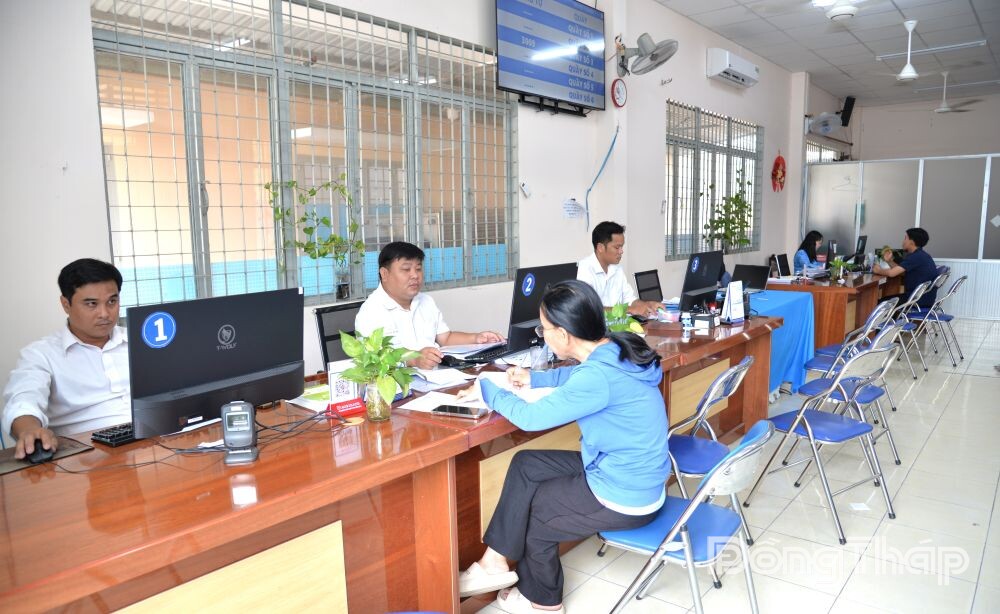
At Public Administration Service Centers across communes and wards, the processing of administrative procedures has become increasingly stable and efficient, gradually fostering a modern, service-oriented administrative culture supported by digital transformation.
Residents visiting the centers receive clear guidance throughout the entire process, from submitting applications and digitizing documents to tracking progress and receiving results. The “one-stop” and “integrated one-stop” service models are no longer new concepts but have become standard practice in the daily delivery of administrative services.
Service counters operate continuously, with officials processing applications through the electronic system while assisting residents in completing their documents correctly from the outset, minimizing repeat visits and reflecting the shift from an administrative mindset to a service-oriented approach.
Mr. Pham Viet Kien, Member of the Provincial Party Committee, Secretary of the My Qui Commune Party Committee, and Chairman of the Commune People’s Council, said that: “The commune’s Public Administration Service Center has received a total of 5,515 applications, including 5,119 submitted online, accounting for 92.8% of the total. The on-time and early completion rate reached 98.12%, while 91.75% of fees were paid online. In the first six months of 2026 alone, the commune received 2,675 applications, of which 2,543 were submitted online, and 2,619 have already been processed.”
These figures demonstrate significant progress in the digital transformation of administrative services, making procedures more convenient for both residents and businesses.
Province-wide, the administrative procedure system has now been standardized with 2,075 procedures, including 1,742 at the provincial level and 333 at the commune level. At the same time, the province has implemented coordinated measures to reorganize public assets and invest in digital infrastructure, providing a solid foundation for digital government.
Information systems supporting government administration, including document management, administrative procedure processing, electronic reporting, and official email, have also been upgraded to ensure seamless operation from the provincial level to all 102 communes and wards.
One year is not a long enough period to fully evaluate a new governance model.
Nevertheless, the initial results have affirmed that Dong Thap is on the right path in reforming its administrative system and modernizing local governance.
More importantly, they reflect a fundamental shift in governing mindset, from administration to public service, with a focus on supporting, action-oriented governance, from traditional administration to digital government, and from development within former administrative boundaries to leveraging the opportunities created by the province’s expanded post-merger development space.
These changes provide a foundation for Dong Thap to further strengthen governance capacity, improve the investment environment, accelerate comprehensive digital transformation, and fully unlock its potential and competitive advantages, driving breakthroughs in socio-economic development in the era of growth.
By LE NGUYEN
Translated by ANH DUC