
IN ANTICIPATION OF THE 136TH BIRTH ANNIVERSARY OF PRESIDENT HO CHI MINH (MAY 19, 1890 - MAY 19, 2026):
The South in His Heart
(DTO) During his lifetime, Uncle Ho always used the most affectionate words when speaking of the South. He referred to the South as “the blood of Vietnam’s blood” and “the flesh of Vietnam’s flesh.” He once said: “The image of the beloved South is always in my heart,” and “As long as the Fatherland remains divided and our compatriots still suffer, I find no peace in my meals or sleep.” Thus, in every slumber, in every meal, and in every joy, Uncle Ho always dedicated a special affection to the South – the “Steel Citadel of the Fatherland.”
Uncle Ho once cherished a wish: “When North and South reunite as one family / And the people are prosperous and the country is strong, only then shall I be satisfied.” On April 30, 1975, the entire nation sang in unison: “As if Uncle Ho were with us on the great victory day.” And every May, on his birth anniversary, the whole country is once again swept with a wave of boundless reverence and enduring gratitude, remembering him sleeplessly.
“THE IMAGE OF THE BELOVED SOUTH IS ALWAYS IN MY HEART”
Uncle Ho’s love encompassed all, but his affection for the South was uniquely profound. For he deeply pitied the fact that “The South goes ahead and returns last,” and that “The South is the Steel Citadel of the Fatherland.”
In 1962, a delegation of the National Front for the Liberation of South Vietnam, led by Professor Nguyen Van Hieu, visited Uncle Ho. That day, the delegation presented him with many “precious gifts,” such as a flower vase crafted from bullet shells and, notably, a poetry collection by poet Trong Tuyen, a martyr who had sacrificed his life on the battlefield. Upon receiving the gifts, Uncle Ho was deeply moved. A comrade from the Party Central Committee Secretariat respectfully asked him:
“Dear Uncle, do you have any gift to send to the South?”
Everyone eagerly waited in suspense to see what gift Uncle Ho would give to the South. He stood silently, looking affectionately at everyone, and then said:
“I have nothing material to give to our southern compatriots. I only have this.” He placed his hand over his chest, where his heart was beating, and said: “This is my gift to the compatriots and soldiers of the South! The image of the beloved South is always in my heart.”
Reflecting on Uncle Ho’s affection for the South, the late Prime Minister Pham Van Dong once remarked: “Uncle Ho’s affection for the South, as well as the South’s affection for Uncle Ho, is an extremely monumental and important theme, carrying both immediate and long-term significance.
Here, I will only say one thing briefly: This sentiment, this mutual affection, is a song that is both heroic and lyrical—as beautiful as the splendid, brocade-like landscape of our southern land, and as beautiful as the patriotism of the southern compatriots and the people nationwide toward the great revolutionary cause of the Vietnamese people.”
UNCLE HO IN THE HEARTS OF THE SOUTHERN PEOPLE
President Ho Chi Minh embodied the faith and victory of the Fatherland and the Vietnamese people. The children of the steadfast Southern "Steel Citadel" always looked toward Uncle Ho with sacred affection.
From the early days of the revolution, the image of Uncle Ho became an endless source of inspiration for any artists. Some painters even used their own blood to create portraits of him as an expression of profound reverence and sacred love for the Fatherland and the revolution.
Respectfully to the venerable Father: Ho Chi Minh. Dear Father! For the past two years, trusting in you and answering your call, I have brought my art into the ranks of the National Guard in Military Zone 8. The August Revolution led by you, our esteemed Father, has liberated my art. Today, amid the grandeur of the unprecedented Independence Day celebration in the South, after listening to your “Declaration of Independence” and your deeply moving, powerful appeal—the resounding chants of “Long live Ho Chi Minh” by the Southern Youth Troop—I was overwhelmed with boundless emotion. In tears, I drew blood from my young arm to paint your portrait, alongside three children from the Central, Southern, and Northern regions gathering closely beneath your beard. This was rendered on a piece of silk captured by our soldiers and people after defeating the enemy at the Battle of Giong Dua in April 1947. Seeing my blood flow, everyone around me was alarmed and hurried to bandage the wound in concern. I replied: “My blood is the blood passed on to me by Father; my blood is the blood of the nation. How would I ever dare waste my blood? My entire body and my whole life already belong to Father.” I respectfully send this painting created with my blood to you, our esteemed Father, to express my gratitude for liberating my art, and for transforming both my body and soul into a sharp weapon to fight for the national liberation revolution. Respectful greetings to Father! Military Zone 8, September 2, 1947 Your son, Diep Minh Chau |
The first artist to paint a portrait of Uncle Ho with his own blood was painter Hoang Tuyen. He was born in 1912 in Tan Trung Commune, Go Cong Dong District, Tien Giang Province (now Dong Thap Province). In August 1945, he joined the revolutionary movement in his hometown.
In October 1945, during a trip from My Tho to Sai Gon, he happened to discover a newspaper carrying a photograph of President Ho Chi Minh. Deeply moved and overjoyed, he carefully kept the newspaper.
After returning from Sai Gon to Giong Nau (Go Cong), with boundless veneration for the beloved Father of the Nation who devoted his entire life to national liberation, he drew blood from his own arm to paint a portrait of President Ho Chi Minh.
Through this unique artwork, he became the first Vietnamese artist to paint a portrait of Uncle Ho using his own blood, expressing the deep reverence of Southern artists and people toward the nation’s leader.
The blood-painted portrait of Uncle Ho was later displayed at a national salvation exhibition in Go Cong Town. In support of the Government of the Democratic Republic of Vietnam’s policy to build an independent national financial system, the painting was then put up for auction.
Before thousands of local citizens, Mr. Truong Van Huyen, a notable figure from Tan Duan Dong Village (Go Cong), was honored to purchase the painting for a very large sum, equivalent to several thousand bushels of rice.
Unfortunately, due to the harsh conditions of war, that priceless masterpiece could not be preserved. This was a great loss not only for painter Hoang Tuyen personally, but also for Vietnamese fine arts.
The second artist to paint a portrait of Uncle Ho with his own blood was painter and sculptor Diep Minh Chau. He was born in 1919 in Nhon Thanh Village, Chau Thanh District, later partly belonged to Ben Tre City (now Vinh Long Province).
At the age of 15, he learned painting from Hoang Tuyen, who later became both his elder brother and mentor, inspiring in him a deep passion for art.
In 1940, he ranked first in the entrance examination to the Indochina College of Fine Arts and studied in Hanoi. In 1945, he returned to his hometown to join the revolution in Ben Tre Town.
At the end of 1946, he began working in Military Zone 8. As a frontline correspondent, Artist Diep Minh Chau traveled with National Guard units to many places such as Go Cong, My Tho, Ben Tre, and Sa Dec...
His paintbrush vividly captured scenes of combat, labor, and production by the soldiers and civilians across the battlefields of Military Zone 8.
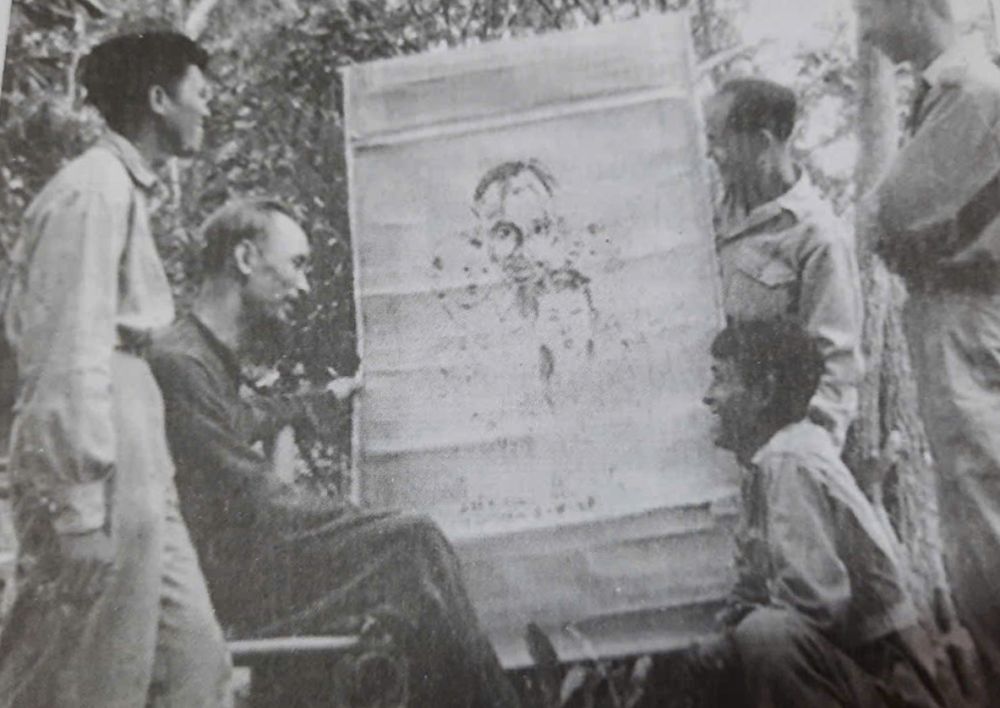
In 1947, he created the blood painting “Uncle Ho and Three Children from the North, Central, and South” with the inscription: “Respectfully dedicated to the venerable Father Ho Chi Minh.”
The blood painting was created by Diep Minh Chau on silk seized as war trophies from French forces after the Victory of Giong Dua in Chau Thanh District, My Tho Province, on April 25, 1947.
Several months later, the artwork was exhibited in Thien Ho on the occasion of the Independence Festival on September 2, 1947.
In 1950, the blood painting “Uncle Ho and Three Children from the North, Central, and South” was brought by a Southern delegation to the Viet Bac resistance base and respectfully presented to President Ho Chi Minh, together with an emotional letter from artist Diep Minh Chau.
Compiled by HONG LE
Translated by X.QUANG